Monday, July 20, 2009

Freddie writes his own scripts !


Never mind the smart analyses. Never mind the psychobabble. Never mind the medical theories and the insider stories. Freddie writes his own scripts and the Flintoff clan, massed in numbers throughout the Lord’s Test, seemed not surprised at the heroics. And nor really were the crowd for whom he is way beyond folk hero status. The timing of his announcement about this being his last Test series just before the second Test match seemed a bit crass and a diversion from the real business at hand. I wasn’t the only commentator to think that perhaps Fred might have waited until the end of the Ashes. But little did we all know that in the honest and straightforward world of Andrew Flintoff once he has made up his mind about something he wants to tell us all about it. And little did we also know that far from being a distraction this would be the motivator that drove Fred on – and which was one of the key factors in England’s splendid Test win.

Fred’s 5 wicket haul finally shut the door on a tenuous Aussie fightback – and it got his name on the bowling honours board at Lord’s for the first time as well. And the only time that I saw Ricky Ponting smile today was when he went over to Freddie and shook him warmly by the hand after the presentation ceremony. Andre Flintoff is not the greatest batsman of his era nor the finest bowler. But his happy knack of playing the vital innings or taking the vital wicket, combined with his unaffected charm and his lack of pretension have made him, if fit, the first name on the teamsheet through most of his career. We have three more opportunities, we must hope, to see Fred in England’s Test match colours – don’t bet against him playing a pivotal role for the rest of the summer aching and sore though he may be for much of the time. Nobody puts bums on seats like Andrew Flintoff – and no-one is more deserving of our thanks both for his achievements and for his unique and utterly beguiling style.

Sunday, July 12, 2009

The ECB has killed their Golden Goose


When Michael Vaughan resigned as England’s Test Captain, and simultaneously Paul Collingwood stood down as limited overs captain, Kevin Pietersen was the obvious if courageous choice to replace them both. He was by some distance England’s best batsman and commentators close to the game all agreed that he was a thoughtful cricketer with a good tactical brain. The skunk-haired tyro had gone and KP’s personal life had settled down with his marriage to the sensible and supportive Jessica Taylor. That is was a choice that required courage came not from the risk that Pietersen would not be worth his place in the team, nor that he lacked tactical awareness, although his captaincy experience was minimal and he would clearly have to learn on the job some aspects of the role. The risk of Pietersen’s appointment was the mirror image of its potential potency – KP is utterly unlike anyone who has ever been an England cricket captain in the past. His fellow South African Tony Greig had a similar southern hemisphere approach which was the reverse of the Cowdrey/May tradition – although his style was not dissimilar to that of Hutton or Illingworth. But Greig grew up in a Cape Province and his father was Scottish – this was the world of English speaking white South Africa and although the culture was obviously different to that of the old country those differences were not huge. Kevin Pietersen, on the other hand, grew up in Pietermaritzburg which was in the heart of Voortrekker country – and that is very different indeed.

To those who may be unfamiliar with white South Africa the differences between those of British Isles origins and those who are Afrikaners are enormous. Language and religion – those most decisive of differentiators are different and so are attitudes to life in general. It is no exaggeration to say that someone like Tony Greig would have far more in common with the British than he would with his Afrikaner fellow South Africans. And Kevin Pietersen, his English mother notwithstanding, grew up in a solidly Afrikaner environment. His strong father seems an archetypical Afrikaner and the values that he instilled in the young Kevin must have been much more South African Dutch than they were South African English. Far more Hansie Cronje than Graeme Smith.

When the England and Wales Cricket Board (ECB) appointed Pietersen as captain they could not have been unaware that his personality and style were completely un-English. True KP had proclaimed his allegiance to England and had an England cricket tattoo on his arm. But one of the reasons that he had already sharply divided opinion among the cricketing chattering classes was that inbred into him was an “in-your-face” competitive style which came in no small measure from his Pietermaritzburg upbringing. This is seen as arrogance and a bit show-poneyish by those for whom Peter May or Colin Cowdrey were the epitomy of how a cricketer should behave. But those on the other side of the argument argued that this was exactly what England cricket needed. In the same way that England only won an Ashes series when they appointed a Southern African coach if we were to do this again, and maybe even win a Limited Overs tournament as well, we need the shock to the system that Kevin Pietersen would bring.

So the ECB took courage in their hands and appointed the very foreign Kevin Pietersen as England’s captain. Results came in immediately with a Test match win and a One Day series victory against South Africa. KP also handled the communications duties of an England captain with aplomb and he looked to be an inspiring captain on the field as well. His body-language was excellent and the England players were clearly responding to the KP enthusiasm. The tour to India was more difficult on the field but Pietersen did well in the hugely different circumstances post the Mumbai attacks. But KP wanted to be in charge, which is what he was taught as a child - there can be only one leader in a team. The trouble was that the England coach Peter Moores thought that he was in charge as well and he was not only a hands-on manager but he had a personal style that was anathema to Pietersen. Moores had been comfortable in the supremely English and rather deferential world of Sussex and this, combined with a pride and bloody-mindedness which came perhaps from his North-country upbringing was a recipe for conflict with Pietersen. The ECB had to choose whether to back their captain or to back their coach – and in the end they backed neither! KP was sacked and Moores dismissed as well.

From the moment that Kevin Pietersen lost the job as England captain he has seemed a totally different person – hardly surprisingly, nobody likes being humiliated. True his natural talent has seen some decent performances but he is indisputably not the same man he was. The smiles, when they come, look forced and in the interviews what were once self-confident statements of intent now sound like parroted platitudes. And at Cardiff we saw a side of Pietersen that suggests that the ECB have more than just the loss of an original and potentially inspiring captain to answer for. KP’s first innings showed that he still has the ability to play a long and careful innings if the circumstances require it – 69 runs off 141 balls is snail-like but it was appropriate, up to the point when he got himself out. Petersen’s shot against Hauritz was not a misjudgment – all batsmen do this from time to time. It was a predetermined unorthodox swipe at an innocuous wide ball that would have been out-of-place on a school playground let alone in a Test match.

It would take a combination of Freud, Jung and Brearley to even begin to understand what is presently going on in Kevin Pietersen’s mind. His second innings dismissal was bizarre not because of the foolishness of the shot, as in the first innings, but because KP usually knows well where his stumps are. Leaving a ball, which then bowls you happens of course but rarely to someone of Pietersen’s natural cricketing talents. Was it fear that led him to leave a ball he could easily have blocked? Who knows – but what is clear is that England’s best batsman has lost the plot and that his mind and his emotions are in turmoil. And the cause of this malaise is clear as well. In the world of competitive sport in which young Kevin grew up you have to win and you have to take personal responsibility for your actions. If you make mistakes you learn from them. Draw a line and start again. That Pietersen made a mistake in his feud with Peter Moores and in the near ultimatum that he gave his employers at the ECB is true. But the ECB, and especially Hugh Morris the ECB’s “Managing Director”, should have been far more understanding and considerate and should have reflected that the change in England’s cricket fortunes that they wanted from the Pietersen appointment would not come if they summarily dismissed him. If they had wanted the May/Cowdrey style of Andrew Strauss the ECB had a couple of earlier occasions when they could have appointed him but they chose the very different Andrew Flintoff and then Kevin Pietersen instead. Strauss’s captaincy at Cardiff has been uninspiring and has been a contributor to England’s downfall. Would things have been different if Kevin Pietersen had still been in charge - I have not the slightest doubt that they would. Not only would Pietersen’s leadership style have been likely to make the Aussies think more that the rather diffident and apologetic Strauss. But KP would have led from the front and by example. If he had been captain it is inconceivable that he would have played the shots that led to his dismissal in both innings.

So the ECB have not only denied themselves the chance of having a competitive Ashes series with Pietersen and Ponting standing foursquare up to each other at every match. They have also turned off and discomforted their best batsman and it is by no means impossible that we have already seen the best of Kevin Pietersen and that instead of being the force that leads England to real international success he becomes little more than a long footnote in modern English cricket history. And if that happens the suits in the ECB offices at Lord’s should be thoroughly ashamed of themselves.

Saturday, July 11, 2009

Five counties down, thirteen to go for Marcus North


“Look mate, you have to be patient if you want to wear the Baggy Green” says Marcus North* when asked how it feels to make an Ashes debut at the age of nearly 30. North impressed with his solid innings of 54* yesterday in a partnership with Michael Clarke which finally killed any remote chnace that England might have had to force a win the first Test match at Cardiff. Asked whether his County experience had helped him North was clear: “Look, my time at Durham in 2004 definitely taught me how to bat on English pitches like this one at Cardiff, then my move to Lancashire in 2005 helped me develop further. Obviously also my spell at Derbyshire in 2006 was very valuable. In 2007 I moved to Gloucestershire and put some firm roots down and played almost a full season for them in 2008. I am also grateful to Hampshire for letting me play for them this year in preparation for the Ashes”.

Asked what he thought of the English county system North was very enthusiastic “It’s bonza mate. Most of us are at a bit of a loose end during the Aussie winter which is our “off-season”. Professionals need to hone their skills and you only have to pick up the phone to one of the counties and offer your services and they jump at the chnace. Mike Hussey showed me the way. He played for Northants, Gloucester and Durham before he played for Oz and reckons that without this experience he might never have got the call-up. Obviously the standard isn’t that high and the games can be a bit of a bore but it’s quite tough now that there are so many South Africans at the counties. I suggested to young Hughesie that he give it a go at Middlesex before The Ashes got underway and they were only to pleased to help. Watch Hughesie go next week on familiar ground at Lord’s!”


* Marcus North's words were crafted for him by Paddy Briggs

Friday, July 10, 2009

Never mind the cricket - try the Chardonnay


The self-congratulatory air in and around Sophia Gardens this week, from Simon Jones to Max Boyce and every Taff in-between, has been stomach churning. Add in the truly ghastly singing by all the male singers who couldn’t be prised away from the microphone (Katherine Jenkins was wonderful though) and you have an event of cloying sentimentality to remind us English why we only under duress cross Offa’s Dyke. That Glamorgan has a cricket tradition I happily acknowledge and that from time to time they have delivered quality players for England (even an England Captain) I thank them for as well. But in truth this tradition gives them no more right to host an Ashes Test match than Gloucestershire or Leicestershire or Sussex or Kent or any of the other counties which play at small country grounds. Quite what the economics of the Welsh Development Agency’s decision to subvent the redevelopment of Glamorgan’s ground are will no doubt remain opaque. In Cardiff this week in the media there was plenty of unaudited bombast about how much money one Ashes Test was bringing to the City. Unaudited and unchallengeable like most of these things it will no doubt become an urban myth that the millions spent on the SWALEC stadium will be covered by all the English and Aussie fans that descended on the city and tried to drink it dry. The Glamorgan board is congratulating themselves about how little the SWALEC cost compared with other grounds – maybe so but surely they could have spent these millions more elegantly; this is a modern ground utterly devoid of any architectural merit. The Pavilion looks like a 1960s secondary modern school.

At the ground my impression was that by far the majority nationality was English and that the Aussies outnumbered the Welsh comfortably. Plastic daffodils and leaks were not much in evidence but there were plenty of Kangaroos. Now this may all sound churlish and bigoted and I apologise for that. But whilst it is true that the organisers have put on a decent show (the flat wicket aside) so they should have – that is a necessary condition of hosting a Test match anywhere. Had this Test been at Trent Bridge or Old Trafford (with their historically far superior claims and their bigger grounds) then of course we know for sure that they would be well organised – they’ve done it for a hundred years or more. And had it been at Durham with their bigger ground and far stronger claim (they have after all already successfully hosted Tests) then few would have complained. There was even a strong argument that the Rosebowl was well ahead of Cardiff in the queue to host a Test. The process by which Cardiff was selected to host an Ashes Test ought to be thoroughly investigated – not by the complicit members of the England and Wales Cricket Board and all their past and present Morgans and Morrises but by an independent body concerned about the way public money is spent. But I doubt that it will happen.

Underpinning the finances of Cardiff’s Test match adventure, aside from public money, was the determined pursuit of commercial sponsorship and of corporate hospitality in particular. That’s the modern world of sporting profit and loss - offensive though it might be for ordinary fans to see hundreds of guests at events who are there to be entertained not by happenings on the field of play but by the food and drink in the corporate lounges. At Cardiff these free-loaders have been given the best seats in the “Really Welsh” (sic) Pavilion and when one of the best passages of play was underway after lunch on the second day, with Freddie Flintoff challenging young Philip Hughes, these seats were virtually empty (see photograph). So were the rows of the pavilion occupied by cricket fans eagerly anticipating the Ashes Test match? Or were they there for the food and the wine and only eventually returned to their seats to sleep off their lunches. You decide!

The Ponting and Katich masterclass


NOTES FROM AN ASHES SUMMER (5)


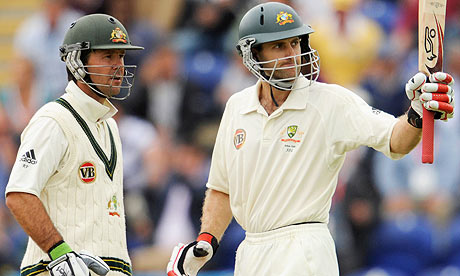
I hope that Kevin Pietersen and the rest of the England top order were watching intently as events unfolded at Cardiff yesterday. Not just at the Ponting and Katich batting masterclass during the last two sessions of the day but also the splendid attack launched by the England lower order in the morning. In their vastly different ways Broad, Anderson and Swann (for England) and Ricky Ponting and Simon Katich (for Australia) showed how to bat on a pudding of a pitch. There are two approaches and international batsmen of quality should be able to follow either. If the wicket is benign and the attack no better than adequate then depending on the state of the match you either get your head down, use your technique and experience and quietly graft your way without taking any risks to a decent score. If, however, you want to dominate the bowling and the state of the match requires that you do this then you can become more adventurous and try and take the attack apart.

On Wednesday afternoon with England 97-3 at lunch Pietersen and Collingwood needed to restore their side’s position so grafting was necessary. They did this well, survived the next session and took England to 192-3 at tea. A few overs later Colly lost his concentration when on 64, and with an Ashes hundred for the taking, he edged a catch to Haddin off an innocuous ball from Hilfenhaus (228-4). Then with the score at 240 Kevin Pietersen played the most gormless shot I have ever seen in cricket at any level to put England back in trouble. All the good work of the afternoon session was undone in two shots – one ill-advised and the other just plain brainless. Back in 1965 the great Ken Barrington was dropped from the England side for taking seven and a half hours to make 137 against New Zealand. And a year later Geoffrey Boycott suffered the same fate for his exceptionally slow batting against India. Pietersen’s wilful, self-centred and grotesque dismissal at Cardiff was surely just as culpable as Barrington and Boycott’s tardiness. Will the England selectors of 2009 have the courage to follow the lead of their predecessors of forty years ago? They certainly should.

Back to the masterclass. Ponting and Katich soon realised that the much hyped slow turner apparently due to appear at Sofia Gardens was either a myth or was a long time a-coming. England were bowling OK but nothing was helping the swing or pace of Flintoff, Anderson or Broad and there was nothing in the pitch for Panesar or Swann either. If they kept their heads they could put Australia into a decent position by the close, and knock on to biggish personal scores as well. Where Colly and KP had blown it from a similar position Punter and Kat clearly weren’t going to do the same. Today if the weather holds and there is no sudden deterioration in the pitch there is no reason at all why Australia can’t push on entertainingly and have a lead of perhaps 150 by the close – and they can win the match from there.

This Cardiff pitch is not fit for competitive Test cricket – at least on the evidence so far. It seems that fears that the pitch would break up and Glamorgan would be shamed by a three day Test (or less) lead not only to the sacking of a groundsman but to a gross over-compensation by his successor. You could play a Durban 1938 length Test match on this pitch and not get a result. Just like in Adelaide in 2006 when after four days the curator was lambasted by all and sundry for the run-rich and bowler unfriendly pitch he delivered in the second Test of the 2006-7 Ashes series. Well we all remember what happened on that fifth day – the pitch didn’t crack up but England did! And don’t write off the possibility of the same happening at Cardiff 2009. This Test match is far from over!

Tuesday, July 07, 2009

The 2009 Ashes begin at last!


Mock ye not! Certainly I won’t be laughing at Glenn McGrath for his 5-0 (to Oz of course) Ashes whitewash prediction – not with my record as a Nostradamus anyway. Only a few weeks ago I predicted confidently that The British Isles Rugby team (aka The Lions) would be beaten by at least 20 points in each of the Test against the Springboks. The final points tally over the three Tests was Boks 63 Lions 74 by the way in case anyone forgets to tally it up. And how wonderfully well the Lions played from that moment in the first Test when they looked down and out at 7-26 early in the second half. Moral victors in the series? Well not quite – South Africa perhaps just about deserved to win but The Lions did all of the inhabitants of our little group of British islands proud didn’t they?

And so to Cardiff. Well I’ve vented my spleen enough about the iniquity of the choice of venue for the first Ashes Test – so now I’ll just head for the M4 and hope for the best. Having discovered laverbread on my last visit to the Principality I’m looking forward to breakfasting again on this mouth-watering dish. At the opening ceremony we are apparently going to hear “Hen Wlad Fy Nhadau” along with “Advance Australia Fair” with the British National Anthem with its reference to Her Maj (Head of State in both participant counties in The Ashes contest) not featuring. I wonder if this is the first sporting occasion when not one member of the home team could understand a word of the “home” anthem – let alone sing it.

Rumours abound about the Cardiff wicket and whether there is a cunning plot underway for Panesar and Swann to roll the Aussie over with their twiddlers. Decent bowlers both but I really do doubt that they strike fear into the hearts of our friends from down under. There will be one or two young Australian batsmen appearing in an Ashes Test for the first time – as a certain Don Bradman did 79 years ago at Trent Bridge. Wisden wrote of the young Don that summer that he was “A glorious driver, he hit the ball very hard, whilst his placing was almost invariably perfect. He scored most of his runs by driving, but he could cut, hook, or turn the ball to leg with almost the same certainty.” Bradman was 21 years old that summer – about the same age as the tyro Philip Hughes this year. I’ll try and put the mockers on Hughes by making the comparison with the Don but it really does seem that he has the same range of shots as his illustrious predecessor. Has he the nerve as well? We shall see.

It is customary to say that bowlers win matches and so it is on the bowling attacks that many commentators are concentrating in there pre-Ashes pieces. I’ll do the opposite and suggest that the key players, other than Hughes, will be the indisputably great Ricky Ponting, the reliable and solid Hussey, the now in-form North and the almost Gilchrist- like Haddin who could be the reason that Australia will have the edge. Mind you if Strauss, Bopara and Pietersen all strike form on the same day – backed up by Cook and Colly and the rest England might post the occasional formidable total themselves. I also have strange gut feel that Ian Bell is going to feature some time during the series and that he will do well – but that as near as I’ll get to a prediction.

Well “Iachydd Dda” to you all – let’s hope for some fine cricket this week!

Thursday, June 18, 2009

Lions led by money men....


I’ll be watching the telecast from Durban on Saturday – of course I will you can’t break the habit of a lifetime. But I find the whole bonanza of a modern Lions tour grotesquely overblown and rather vulgar.

I reckon that I was at the very last Lions international that really mattered – at Ellis Park back in 1997. In those days the Lions were still called the “British Lions” of course – the correct colloquialism for what was, and always had been, the “British Isles” rugby team. And in those days rugby was still (mostly) an amateur sport. The excitement came from the fact that top class rugby would be played by two teams most of whose players played only for the love of the game. And the team had still its traditional name without anybody, least of all the Irish players, really caring that some ignoramus might think that the “British” in the “British Lions” referred to a country rather than to geography. But now so as not to upset a few dim-witted Irish nationalists we have to use the ghastly solecism “British and Irish Lions”. What nonsense.

The Lions famously won that tour in 1997, but they haven’t won since (one lone Test in Australia aside) and the last tour to New Zealand was an embarrassment. But whilst the tours have become more and more one-sided the hype and the commercialisation has escalated. The replica Lions shirt in the RFU shop costs £99.99 - a mark-up, I suspect, of perhaps £95 over the production costs. And the advertisement from Thomas Cook offered tours starting from £1999 to see one "Test" and £2499 to see two. And that pretty much sums up the rationale for this year's commercial bonanza in South Africa.

The Lions in 2005 were not humiliated by the All Blacks because of the deficiencies of Alastair Campbell nor by the mistakes of Clive Woodward. They were beaten because a southern hemisphere side will never again be beaten by a rag, tag and bobtail assemblage of British Isles players, however individually talented these players may be.

The South Africans are full time professionals both individually and as a unit. The hastily assembled Lions cannot possibly be expected to gel together as efficiently and skilfully as the Springboks – they will be lucky to avoid defeat by less than twenty points in any of their matches against the Boks.

In the days of amateur international rugby there was a logic and, yes, a romance about the Lions that led to some heroic achievements. But in the professional era a side which plays together continuously for a year or more, as the South Africans will have done, will have a huge edge over a mishmash of players who cannot possibly be as familiar with one another as their opponents will be.

The only justification for the continued existence of the Lions is the commercial bonanza that a Lions tour creates. For me that is insufficient reason for the tour to go ahead - and certainly there is no case at all for international caps to continue to be awarded for these one-sided and irrelevant matches.

John Shepherd - The Loyal Cavalier


John Shepherd – The Loyal Cavalier
by
Paddy Briggs

Published by ACS Publications


John Shepherd was a leading allrounder in first-class cricket in England in the 1970s and 1980s. He was a loyal servant of Kent for seventeen seasons and of Gloucestershire, as player and coach, for seven more. 'Shep' was born in Barbados where his natural talent was spotted and nurtured by Everton Weekes, one of the 'three Ws'. He was brought to England by Kent in 1965 and his successful adaptation to county cricket led to awards as the leading allrounder in English cricket in 1968, Wisden Cricketer of the Year in 1979, and to recognition in five Tests for the West Indies.

Paddy Briggs brings a journalist's eye to Shep's early years in the Caribbean, his brief Test career, his controversial involvement in tours to Southern Africa in the apartheid era, his clumsy sacking by Kent in 1981 and his late‑flowering achievements with Gloucestershire in the 1980s. In a thoughtful and challenging “Introduction” Paddy also unravels some of the complex influences on cricket in Shep’s years in the game and draws some telling contrasts with cricket today. Throughout his career Shep was the most loyal of players and colleagues: his gloriously cavalier batting made him a special favourite with fans. His loyalty and effort are well‑described in a candid telling of his story.


The book was successfully launched on a gloriously sunny day at Tunbridge Wells this week. The popular Shep drew a long line of well-wishers (and book buyers!) to the marquee of the Kent Supporters Club.


Signed copies of "John Shepherd - The Loyal Cavalier" are avaialable @ £12 post free from the author, Paddy Briggs, at 40, Broom Park, Teddington, Middlesex TW11 9RS. Cheques made out to P.S.Briggs please


Wednesday, June 10, 2009

Fine catch by one of the MCC faithful...


The modest celebrations of the MCC member who took a fine catch in the Pavilion at Lord's on 9th June 2009. Your correspondent is extreme left standing to applaud (and relieved that the ball didn't come to him)!

Saturday, June 06, 2009

Hats off to Lord’s, thumbs down to England


NOTES FROM AN ASHES SUMMER (3)

Hats off to Lord’s, thumbs down to England


The orange Dutch hats were thrown high in the air last night to cap a famous and fully deserved victory for the team from The Netherlands against hosts England in the opening match in this year’s ICC World Twenty20. We were denied the pleasures of hearing and seeing Alesha Dixon perform as the opening ceremony was cancelled for “Health and Safety” reasons (quite what these reasons were we weren’t told). For a moment I did wonder if a hastily arranged song from a new “Three Tenors” group had been substituted, but no - it was only ICC President David Morgan, ECB Supremo Giles Clarke and the Duke of Kent who were on the makeshift días in front of the Pavilion. Morgan and The Duke made speeches of predictable banality (we were spared Clarke) – and then, at last, the stage was set for the real business of the day. That we saw play at all we must thank the MCC who have installed permanent floodlights at the home of cricket that not only look elegant but work superbly -they weren’t supposed to be used yesterday but the skies were leaden and without them I suspect we wouldn’t have had a full match. Similarly the modern Lord’s drainage system is so good that within minutes of the rain ceasing the ground was fit for play – a stark contrast with Headingley a couple of weeks ago.

At the end of the eleventh over England was 100-0 with Bopara and Wright coasting along nicely. A score of approaching 200 seemed in prospect but the Dutch were not wilting and stuck to their task to good effect. The final nine overs delivered only 62 runs with just four boundaries - and there was not one six in the whole innings. Shah, Morgan and Collingwood were out to particularly inept shots and with all due respect to his talents Rob Key was not the figure you might hope to see coming to the wicket when you are 144-4 with 22 balls to go. He duly failed to hit a boundary off any of the eight balls he received. Note for Morgan: if you are going to decide before the ball is bowled that you will play a reverse sweep do check that there isn’t a fielder standing in the way! Surely given the good start a team of (mostly) experienced professional cricketers should have been able to put the game out of reach of a Dutch side many of whom play only for the love of the game. The killer instinct was missing, as was the injured Kevin Pietersen, and England’s total was respectable when it should have been unreachable.

That the Dutch won was mostly, I think, attributable to their greater will-to-win and self belief. The batted with enterprise and skill attacking the bad balls and hitting four towering sixes in their innings (one of which might have woken up a few people in the MCC President’s box). By the time it dawned on England that they really good lose the match it was almost too late – the Dutch paced their chase wonderfully well. In the end there was a nail-biting final over and there could have been any one of three results off the final ball. But the Dutch deserved their win and England added a new item to their list of disappointments in international limited overs cricket by losing to a “minnow” for the first time. The Dutch have an expression “Goed is wel, maar beter wint” which in a sporting context roughly means “It’s alright to play well, but you need to play better than that to win” – a lesson England could certainly learn.

Friday, June 05, 2009

A typically English farce at Hove


Back in 1956 John Osborne wrote a play, The Entertainer, which captured brilliantly the muddle and complacency of Englishness. The story of an aging Music Hall artist, Archie Rice, in a third-rate and crumbling theatre, was a metaphor for what many felt to be an England with an anachronistic leader (Eden) presiding over a country which was once famously described by an American Secretary of State as a nation which had “lost an empire and failed to find a role.”

It may be rather fanciful to describe last night’s Twenty20 match at Hove as a metaphor for anything but at the end of the farcical proceedings I couldn’t help feeling that there was something utterly English, and particularly something which typified the state of English cricket, about the proceedings. For those who missed it the match was between Sussex and Kent and it took place on the home county’s rather ugly little ground at Hove. The ground appeared to be perhaps half full – maybe a little more – a disappointing crowd for what should have been a money-spinner between local rivals. It was a day/night match starting at a time which would allow spectators to come from work and it was also televised live by Sky. It was pretty lacklustre stuff from the start with only a small amount of excitement generated in Sussex’s uninspiring innings of 131-3 with only thirteen boundaries. The star performer was the West Indian Dwayne Smith who scored a decent 69 not out off 59 balls but the Kent bowling looked far from threatening and Sussex really should have scored more and taken more chances with plenty of wickets in hand. As the dull Sussex innings proceeded it became clear that there was a problem with the lights – only two of the four floodlight masts appeared to be working. The culpability of the Sussex County Club was clear, although they will no doubt pass the blame to others. But the facts speak for themselves – they failed to provide proper floodlighting for a high-ish profile and televised day/night match!

But whilst Sussex’s administrators should this morning be wriggling with guilt those in charge of the cricket proceedings on the day, on and off the filed, should feel embarrassed as well. No decision was made about an agreed limit to Kent’s innings (it was clear that they would not get 20 overs in). So the Kent batsmen knew only that if they batted for five overs there would be a match but that how long the match would last was, literally, in the lap of the Gods – and of the umpires. Everything was stacked in Kent’s favour. With the end of the match fast approaching all they needed to do was attack the bowling so that they were well ahead on the Duckworth/Lewis rule whenever the match ended. The loss of a couple of wickets wouldn’t have mattered too much if they could pile up the runs quickly. Instead the two openers Denly and Stevens plodded along at less than six runs an over and with only eight boundaries in the eleven overs they were at the crease before the light became too bad and the umpires called the players off. Unbelievably Kent managed actually to be a couple of runs behind the D/L par score when this happened so despite not having lost any wickets they lost the match! It was tactically inept, spineless batting which defied comprehension.

And so this absurd and derisory spectacle came to an end with the home side winning a match that they should have lost and the visitors being denied points by their own ignorance and incompetence. The Sussex administrators, the umpires and many of the players seemed confused by the proceedings which were a parody of competitive sport and about as far removed from the excitement of the Indian Premier League as it is possible to get. And the metaphor? Well nobody took charge, the spectators were kept in the dark (quite literally, some of them), the match descended from one which was dull and unambitious into a farce. All very English you might think in these cheerless old times. Oh Dear!

Monday, May 11, 2009

OCCASIONAL NOTES ON AN ASHES SUMMER (1)


The 2009 “Ashes” summer opened for me with a most unexpected early skirmish. Mrs B and I were en route to the launch party for Peter “Test Match Special” Baxter’s charming new book of reminiscences “Inside the Box”. We were trying to find the hidden entrance to the Lord’s adjacent Danubius hotel when I was aware that someone else was similarly lost and confused. “Are you looking for the Baxter bash?” I said cordially to the chap. “Yes. Round the corner I think” he replied “I’m Adam Mountford by the way”. Mountford (pictured), as TMS fans will be aware, took over as Producer of the programme from Baxter in 2008. Now in my occasional scribblings about the great cricket institution that is Test Match Special I have, I admit, been less than polite about the direction in which it has sailed under Mountford’s tyro stewardship. But, as far as I can recall, I have never directly abused or insulted said Adam in any way. So imagine my surprise when after I had introduced myself Mountford took a deep breath and launched into an unprovoked verbal assault on me and my scribblings as we continued to navigate our way towards the hotel entrance. The essence of Mountford’s accusations was that I should be more sensitive to the feelings of those that I write about – presumably starting with him!

Thoughts along the lines of Harry Truman’s “If you can't stand the heat, get out of the kitchen” spring to mind for although I am still learning my craft as a sports writer one thing that I have learned is that it is a pretty rough profession at times. Michael Henderson referred to Radio 5 Live in a recent article in The Guardian as “Radio Halfwit” and described comments on a Test match by one of that channel’s presenters as being of “…mind-boggling stupidity from the kind of folk who gave the station its reputation.” Now Mr Mountford hails from Radio 5 and is overseeing the integration of TMS into Radio 5’s style – a process regarded by Peter Baxter and most of the traditional TMS team with horror. As Baxter says in his book TMS is popular “…precisely because it did not sound like the Rest of Radio 5”.One of the TMS veterans told me at the book launch that Mountford is only doing what his masters have told him to do - although this has led to accusations that the programme is dumbing down. Few TMS aficionados welcome this process and you can be quite sure that the old TMS team are appalled by any suggestion that TMS needs to move down market - I have heard Henry Blofeld close to apoplexy at the thought as you can imagine.

My criticisms of the Mountford approach to Test Match Special are far from a lone voice in the wilderness so quite why he harangued me so strongly I’m not sure. I told him in response that many of us feel that he is in danger of ****ing up TMS and that that would be a disgrace. We then parted rather roughly and steered clear of one another for the rest of the evening. When I told one TMS stalwart what had happened he suggested that Adam Mountford was not over-burdened with social skills. Hmmm!

If I have never wittingly personalised an attack on Mountford the same perhaps might not be true of all my writings on the ECB Chairman Giles Clarke – a bête noire of many (all?) of us who really care about England cricket. Clarke was also at the Baxter book event and perhaps emboldened by a glass or two of Veuve Clicquot I introduced myself to him - “I’m afraid I have been rather rude about you in my writings” I said to him by way of introduction. “That’s alright”, he said, with what I think was a smile – he was perfectly affable to me. Clarke has a reputation for not always being the most charming man in the room but he treated me perfectly courteously and whilst I cannot claim that he is my new best friend I think that, as Blowers might say, I have more chance (albeit slim) of being on his Christmas Card list then I do of being on the prickly Mr Mountford’s!

Tuesday, April 28, 2009

Seeds of revolution sown in the Long Room


The remarkable success of William Buckland’s iconoclastic book “Pommies” in reaching the short list of four in the Cricket Society/MCC “Book of the Year” Award 2009 will have surprised some of the more traditional members of the two venerable sponsoring institutions. If they are inspired by Buckland’s success actually to read the book they will find that it is a devastating, well-researched and cogently argued assault on England cricket’s decades of failure. Central to Buckland’s argument is the comparison he makes with cricket in Australia – in every single area of cricket performance and governance England’s approach and structure lags far behind what have for years been the successful norms down under.

For Buckland’s book to reach the short list was a triumph for those who have argued for years that just tinkering with England’s archaic cricket structure will not work. A revolution is needed, and Buckland provides the rationale and the reasoning to support the case for a radical insurgency of action – and as a result that may now be at last be about to happen. Chief amongst the author’s contentions is that the traditional county structure of eighteen County Clubs is unsustainable. He advocates that there should be only five “second tier” teams (International cricket is the first-tier) based on five English and Welsh regions. The current county structure would be abandoned entirely in the interests of creating genuinely competitive second-tier cricket and of ensuring that the huge revenues of the ECB are spent far more effectively than at present.

Although “Pommies” did not win the award at the presentation ceremony in the Long Room at Lord’s on Monday 27th April (that went to the rather more traditional book of reminiscences by Cricket Society President John Barclay “Life beyond the Airing Cupboard”) the book is now very firmly launched as a major contribution about the future of cricket in England. The MC of the event was Christopher Martin-Jenkins – one of county cricket’s most vocal and passionate supporters. In his speech CMJ spent as much time on “Pommies” as he did on the other three shortlisted contenders put together and even he had to admit that “perhaps” the case for fewer first-class counties has its merits. There may be room for give and take somewhere between the extremes of Buckland’s revolution and CMJ’s hints of more gentle and measured approach. But William Buckland is unlikely himself to be too keen on compromise. For, as he so emphatically puts it at the end of his book:

“Despite the example and the lessons [of Australia] we [in England] remain clinging to the flotsam of the past like deluded children. That’s why they call us Pommies”

Saturday, April 11, 2009

Twenty20 – The Future?


If it ain’t broke don’t try and fix it? True of course but has the success of Twenty20 in its present form clouded thoughts as to whether the construct as we now have it is the best that we could have? These thoughts have been promoted by watching the Melrose Sevens in Scotland and considering why Sevens Rugby is such a success – without it in any way damaging the value of the “real” rugby game (80 minutes and 15-a-side). The answer in respect of Rugby Sevens is that it is an abbreviated form of the game in every way. It lasts 14 or in some case 20 minutes rather than 80. It has seven-a-side rather than fifteen. It eliminates things like line-outs which could slow up the action. In short it is a close cousin of fifteen-a-side rugby without the pretence that it is just a sidestepping variant of the big game. It’s a sport in its own right.

Consider the Rugby precedent for cricket. The parallels are clear. Twenty20 has 40 overs rather than 100 in traditional limited overs matches. It lasts a few hours rather than a day (or more). And yet it is still an eleven-a-side game. Why? With eleven batsmen available in just twenty overs wickets are somewhat devalued. Even if you are 30-4 after five overs you still have six batsmen available to help you out of the mire. Slog your way into trouble and you can finesse your way out of it. But what if wickets were given more value – the bowlers, currently seen as being economy rather than wicket-taking operatives, would surely come back into their own?

So why not make Twnety20 6-a-side rather than eleven? Suddenly the game changes and ironically it changes back in the direction of traditional cricket (with its battle between bat and ball) rather than further away from it. With six-a-side batsmen might thrash and slog a wee bit less because their wickets would be rather more valued. And if you legislated that of the fielding side all five players (i.e. other than the wicketkeeper) would bowl four overs each what fun that would be! The Captains would have to decide when to bowl their star batters who don’t normally bowl at all – and the batsmen would have to “go for” these bowlers in order to take advantage of their more limited bowling skills.

Warming to the theme there would be no need for field restrictions or power plays. With only five outfielders the captains would have to think hard about field placement. Putting them all on the boundary wouldn’t work because with the opponents only having six batsmen you have to go for wickets don’t you? Indeed the fielding captain would have a great challenge in respect of handling his bowling attack given that he knows that all of his players must bowl. Why not – bowlers have to bat, so why not have a rule that in the shortest from of the game batsmen have to bowl?

The recognition that Twenty20 is a different game from traditional cricket is surely not too great an intellectual leap to make. The creation of a revised version of the game that restores the balance between bowler and batsman and makes wickets valued (which in proper cricket they must surely always be) is a step forward. And the idea that all cricketers have to bat, bowl and field like panthers is surely an appropriate interest-raising novelty – and good for improving the for the athletic image of the game. Worth a try – why not?

Wednesday, April 01, 2009

ENGLAND AND WALES CRICKET BOARD FRANCHISE INVITATION


ENGLAND AND WALES CRICKET BOARD FRANCHISE INVITATION
1ST APRIL 2009


The "England and Wales Cricket Board" (ECB) is calling for suitably qualified sports institutions to bid for one of eight Superpro franchises which will commence operations in the 2010 cricket season.

The Superpro franchises will receive substantial financial support from the ECB including assistance towards operating costs, capital investment programmes and promotional and other expenses. In return each franchise will offer the ECB the following:


At least one sports stadium and associated infrastructure capable of hosting international cricket matches attended by at least 30,000 spectators - and preferably 40,000.

State of the art and suitably staffed coaching facilities including an indoor cricket school, medical and fitness facilities etc. To include a Head Coach of international standard supported by coaches covering all physical and mental aspects of the game of cricket.

A squad of players identified as meeting the highest standards as measured by cricket's "Centre of Excellence" and all of whom are on contracts for at least two full seasons. The squad would be expected to comprise around 18 players of whom no more than two should not be qualified to represent England now or within the next two years.

Teams selected for the Superpro franchise will compete in Four-day and Limited Overs tournaments during the English cricket season. These tournaments will be well sponsored and well funded. Each Superpro franchise will be allocated three players who are currently on England central contracts and these players will appear for the Superpro franchise, at no cost to the franchisee, whenever international commitments permit.

With the establishment of the Superpro franchises ECB support for existing County Cricket Clubs will cease. It is expected that some existing County Clubs will wish to bid for a Superpro franchise along with other suitably qualified institutions such as Football, Rugby and other sports clubs.

Applications to the ECB at Lord's Cricket Ground.

Tuesday, March 31, 2009

Who is responsible for the corpse of England cricket?


Events of the last few months, which has seen England cricket descend into a shambolic mess, almost defy comment or parody. If we forensically try and identify the guilty party I suspect that it will turn out to be rather like “Murder on the Orient Express” where it transpired that everyone had killed the victim and there was no single culprit. But in keeping with the mood of these difficult economic times, when most of us point the finger at the well-heeled fat cats at the top of the pile as being to blame for the mess we are in, I personally have no hesitation in naming the Chairman of the England and Wales Cricket Board (ECB) Giles Clarke as the main reason for our cricket malaise.

Clarke must go
Rants passim have covered Clarke’s elitism (he referred to those with no access to satellite TV as “less fortunate members of society”) ignorance (which led to the nonsense of Stanford), and complacency (he has failed completely to get to the heart of English cricket’s problems with reform of the unsustainable county structure). To this list we can now add gross insensitivity. Clarke sits on top of a hierarchy but seems to have no feelings for the inter-personal issues down the line – Vaughan, Collingwood, Moores, and Pietersen. And he can’t opt out by saying, as he did, that the coach/captain spat was "… a matter for Hugh Morris". The buck doesn’t stop with Mr Morris or even Morris’s boss David Collier. It stops with Clarke - and he better wake up to the fact soon. For the first time in living memory the flagship BBC current affairs programme Newsnight covered the English cricket disarray – and Clarke should have been there to face up to Jeremy Paxman and tell it as the ECB saw it - not leave it to his predecessor but one Lord MacLaurin.


England’s Ashes chances have been weakened
You are left numb by all the shenanigans and the conclusion that you come to is that England cricket has some sort of death wish. Shane Warne said shortly before the hurricane hit Lord’s that if “If England play well and win a couple of series …then I think you’ve got a real good chance and [The Ashes] should be one hell of a series”. But now, whilst Australia certainly struggled a bit at home they seem reborn in South Africa with some startlingly good new young players. Who would now confidently bet on England regaining The Ashes this summer? With KP in charge (and I mean IN CHARGE) I would have been reasonably confident. Whilst he is a different character in many ways from Graeme Smith he shares his fellow South African’s will to win and bloody-mindedness. Just what you need successfully to take on Ricky Ponting – as Smith has so recently shown. Andrew Strauss is a good bloke and a fine cricketer. But I don’t expect to see him in Ponting’s face in the same way that KP would have been and my guess is that Punter will not be quaking in his boots at the prospect of facing Straussy.

The Establishment versus the maverick captains.
Over the years there has always been a struggle in England selection circles between the competing claims of the more establishment figures and the riskier but bullish appeal of the less respectful and non-conformist captains. Colin Cowdrey (Tonbridge and Oxford) versus Ray Illingworth (Pudsey and the University of Life). Mike Brearley versus Tony Greig. Mike Atherton versus Nasser Husain and so on. For the ECB to take the risk of appointing Kevin Pietersen was surprising – that they failed to manage him and ditched him pretty unceremoniously after only five months is not.

Trying to cheer up
My usually sunny disposition has been dealt a blow recently and I’m sure that this is some thing that I share with most of my blogs knowledgeable readers. So as we go around with our countenances dull I suspect that for most of us it is more in sorrow than in anger. I’m angry that just when it seemed we would be safe to go back into the stands to watch a brave and buoyant England take on the old enemy under a leader with charisma and style instead we will start on the back foot. The performances in the West Indies have shown what happens when you have shambles at the top - the lack of spine, focus and intent has been deplorable. I’ll never forgive Giles Clarke for so incompetently and thoughtlessly landing us in this almighty mess. I wonder if he really cares?


Grounds for concern
Somewhat lost in the deluge of publicity about the England captaincy and coach was the announcement from the ECB about the allocation of Test matches to grounds in the future. This included the statement that Lord’s will not automatically get even one Test match per year from 2012. This came as a bolt out of the blue to the Marylebone Cricket Club and if followed through it will scupper their redevelopment plans completely. These plans, which would have seen significant investment and a substantial increase in seating capacity, were predicated on Lord’s having at least one Test match per year - plus some of the other big occasions such One Day Internationals and domestic finals as at present.

One of the many good things in Williams Buckland’s excellent book “Pommies” was his contention that one of the things that holds England cricket back is the low capacity of our main cricket grounds compared with the Aussies. Australia’s smallest ground Perth is bigger for Ashes matches than England’s largest, the current Lord’s. The redevelopment of Lord’s would have a least meant that we have one decent -sized ground but that now looks unlikely to happen. Buckland recommended that we should have fewer but much bigger international grounds – the ECB looks to be going for the exact opposite and no doubt if Giles Clarke gets his way we’ll have a Ashes Test match at Taunton in 2013 - his predecessor David Morgan shamelessly got one for Cardiff this year after all!. Morgan’s fellow member of the Taffia, Hugh Morris, explained the ECB’s thinking: "It's important for people in different parts of the country to see cricket.”. Indeed it is Hugh boyo – and the best way to do that is to get bigger grounds - and to get International cricket back on terrestrial television!

An earlier version of this blog appeared in the cricket fanzine Yes, No, Sorry.

Wednesday, March 25, 2009

Meet John Shepherd at Tunbridge Wells


Kent CCSC members have a special opportunity to renew acquaintance with Kent stalwart and favourite John Shepherd on the first day of the County Championship match versus Essex on Tuesday June 16th.

Paddy Briggs (a Kent CCSC member) has written a biography of Shep and it is being published in early June. Both Paddy and Shep himself will be in the Supporters Club Marquee at lunchtime on the first day of the match to meet members and to sign copies of the book which will be on sale.

Thursday, February 26, 2009

MCC Members want an enquiry into the England and Wales Cricket Board


Some members of the Marylebone Cricket Club have called for an enquiry into the affairs of the ECB and hope to rustle up enough support amongst fellow members to call a Special General Meeting (SGM) of the Club.

The activist members are calling for an SGM “to approve the creation of an MCC Board of Enquiry to investigate the affairs of the English Cricket Board (ECB) and recommend a Cricket Constitution that is appropriate for the governing body of our national sport”

The allegations, which can be seen in full on the website accessible by visiting mccmembers.co.uk say that English cricket is under “…the unregulated control of a private company that is neither publicly accountable nor properly constituted” and that “recent events prove the ECB is guilty of bringing the game into disrepute”

Paddy’s Sports View has previously described the deteriorating relationship between the MCC and their tenants the England and Wales Cricket Board. Clearly a significant body of members want to use the MCC’s status as a guardian of the sport of cricket aggressively to challenge the ECB’s role, particularly in the light of the recent debacles of the England team’s captaincy and the Stanford affair. As this blog has also argued the ECB has no mechanisms whereby it is accountable to anyone in English cricket other than the Chairman of the eighteen First Class Counties along with the Secretary of the MCC. The MCC however as a private members club is owned by and accountable to its members. So whilst there is no forum, other than in the media, whereby the ECB can be held to account by ordinary cricket followers the MCC Committee is constitutionally required to call an SGM if 180 members support a request to do so.

In the event that the MCC Committee is required by sufficient members to call an SGM the meeting would not be in the public domain but it is likely that everything discussed at the meeting will become public knowledge. The MCC’s membership is a broad church and is by no means made up only of establishment figures! A robust debate of the ECB’s recent actions, constitution and performance can be expected with no holds barred. Whilst the ECB cannot be required to attend any such meeting some of the Board’s members are themselves alos members of the MCC and may choose to attend and to speak.

That a number of members of MCC are so aggrieved by the ineptitude and questionable governance of England cricket carried out by Giles Clarke, David Collier and others is admirable and their attempts to get 180 members in total to support their call for the membership fully to discuss the matter deserves support.

Sunday, February 22, 2009

Open Letter to David Collier


Dear David

It seems that you feel that you have no reason to resign over the Stanford debacle and that Giles Clarke and the rest of the ECB board support you – well they would say that wouldn’t they?

A recent poll in The Guardian reported that 86% of respondents thought that Giles Clarke should resign. And even allowing for a bit of bias from the medium and statistical error that shows what the vast majority of the cricket loving public in England think as well. And as Clarke himself has made clear the monkey sits as much on your back as it does on his. After all you are the senior employee of the ECB and you had a clear accountability for the Stanford deal.

The overwhelming tenor of the comments in the media, on cricket websites and throughout the country is that this scandal is one too far for the ECB and that the responsibility lies fairly and squarely with Giles Clarke and with you. You might argue about the minutiae of the due diligence carried out on Stanford and whether it should have covered more that just his ability to pay. You may argue, as you have, that you "believe therefore that I could not have done more at that time and I don't think the board could have done more.” Few objective observers would concur with that self-promoting claptrap.

David the time has come to go. Your position is untenable. "You have sat too long here for any good you have been doing. Depart, I say, and let us have done with you. In the name of God, go."


Sincerely

Paddy Briggs

Thursday, February 19, 2009

Scandalously the ECB is accountable to those they pay, not those who pay them


The series of disasters at the England and Wales Cricket Board (ECB), culminating in the Stanford scandal, can at least in part be attributable to the fact that the ECB is accountable to those they pay, not those who pay them. It is a tenet of proper systems of governance that leaders are accountable to their paymasters or their electorates – whether it is a vote of shareholders or of politicians from time to time an election takes place which holds business and political leaders to account, nominally at least. At the ECB the reverse applies.

Only a couple of weeks ago the chairmen of the First Class counties, plus a representative from the MCC, re-appointed Giles Clarke as Chairman of the ECB. The evidence against Clarke, well articulated by his rival Lord Marland and others, was damning and had it been the cricket loving public in Britain who were making the choice he would have been out on his ear. But it wasn’t. It was the Chairmen of the counties and like turkeys they weren’t going to vote for Christmas. The Christmas they wanted to avoid was the proper and structural review of English domestic cricket that the ECB has been ducking for years. Such a root and branch review, which Jonathan Marland would certainly have instituted, would have properly investigated not just the way that the ECB is funded and the rather opaque corporate structure that it has, but also and most importantly how that money is spent. The likelihood that a proper and honest review would have recommended a substantial reduction in the number of First Class counties in England and Wales is high. And that is where the turkeys come in.

There can be little doubt that Giles Clarke will have given behind-the-scenes assurances to the counties that there futures are secure and that ECB funding will continue – at least so long as he remains Chairman. Such an overblown future for English cricket has been condemned by many objective observers who are not themselves reliant on ECB patronage. Even Lord MacLaurin, no enemy of the ECB, has called for the number of counties to be reduced from 18 to 12 and many other critics of the present system would go much further. William Buckland in his thoughtful and well argued book “Pommies” said that second tier English cricket (currently the County system) should have no more than five or six teams in it – in line with the systems that exist in most of the rest of the cricket world.

The counties fear of radical change combined with the patronage they have received from Giles Clarke has probably protected his position for the time being - even though his hands and those of his CEO David Collier are tainted by their association with Stanford. Unless these two fall on their swords - and the loss of a substantial salary (in Collier’s case) and munificent perks and privileges (in both cases) are such that they will no doubt fight to the end to avoid this honourable step. And the County chairmen? Will they really continue to contemplate their own navels and look away from the ugliness that hangs over the ECB at present? Don’t bet against it!

Wednesday, February 18, 2009

Giles Clarke's position is unsustainable


The "temporary restraining order on charges of major fraud" in respect of Sir Allen Stanford shows beyond any reasonable doubt how ill-advised Giles Clarke and the rest of the England and Wales Cricket Board (ECB) were to get themselves involved with this dubious individual. But whilst these revelations are perhaps the most damning to the prospects of Clarke remaining at the helm of English cricket they are just one in a long line of errors of judgment and taste that has seen the ECB descend into a fetid and morally indefensible pit. The failure to permit live International cricket on terrestrial TV, the squandering of the ECB’s substantial income on an unsustainable and moribund county structure and the total inability of the ECB’s management to apply firm and sensitive leadership over the England captaincy are by no means the only examples which along with the Stanford fiasco have dragged England cricket into the mire. Clarke must go.

Tuesday, February 17, 2009

MCC members in anoraks - shock horror


"Cricket is a leisure activity and we have to decide whether we want a number of anoraks at matches or a large crowd who are keen to be entertained." Giles Clarke recently re-elected Chairman of the England and Wales Cricket Board.


Mr Clarke was commentating on the MCC’s embryonic plans to hold floodlit Test matches at Lord’s Cricket Ground – something that will be technically feasible once Lord’s new retractable floodlights are operational and providing a solution is found to the problem of getting a Test match ball of a colour that can be picked out by fielders against a dark sky.

In these straightened times one would have thought that Clarke would have wanted to encourage all cricket lovers to come to England matches, anoraks or not. But as Richard Williams in “The Guardian” has pointed out there is a possibility that Clarke’s “Casual dismissal of anoraks could be interpreted to include most of those occupying the seats in the [Lord’s] pavilion”.

Put aside for a minute the grave sartorial implications of an MCC member being allowed to occupy a pavilion seat in an anorak and assume for a moment that Clarke did indeed mean those of us privileged to wear the egg and bacon tie and sit in splendour in the magnificent pavilion of the world’s greatest cricket ground. If Williams is right that Giles Clarke has us in his sights then the evidence to support that this is so is compelling. The MCC has a £200million redevelopment plan that will see the capacity of Lord’s increase substantially from around 30,000 to nearer 40,000 spectators - further widening the gap between what is already England’s largest cricket ground and the rest. This plan will be funded from MCC’s own resources and borrowings and for this to be viable some certainty about the future of international matches at the ground is required. But whilst the ECB, whose home is at Lord’s, is fully aware of the MCC’s plans their reaction has been less than encouraging.

Rather than supporting MCC’s plans to create a cricket ground that is not just full of history but actually can be full of a world class sized crowd the ECB looks to be going in the opposite direction. The ECB’s Managing Director of England Cricket Hugh Morris, explained the ECB’s thinking at the end of last year when he said that the ECB’s new “international staging agreements” will guarantee Lord's only two Tests from 2012-2016. "It's important for people in different parts of the country to see cricket” said Morris – this from the organisation that has cast live international cricket from terrestrial television for the foreseeable future by renewing their deal with Sky! It defies belief that the ECB could shun Lord’s in this way whilst giving longer term deals to the much smaller grounds at The Oval (23,500 capacity) and Headingley (planned capacity 20,000) until 2022 and 2019 respectively.

Back to the anoraks. The ECB’s contempt for Lord’s is no doubt built on a dislike of what Giles Clarke and his mercenary band see as the presence of a superior elite amongst its owners at MCC. Members do not pay to attend international or any other matches at the ground – other, that is, than by paying our annual subscriptions and none of the cash from this source finds its way into the ECB’s coffers. We also, in defiance of ICC and ECB rules, may take into the ground a modest amount of alcoholic drinks to accompany us through the long cricket day. Many MCC members feel strongly about the inadequacy they see in the ECB’s governance of cricket “The ECB is not properly accountable and no constitution exists that should reflect its role as a public body governing a national sport” as one outspoken MCC member puts it. There is no love lost between many in the MCC and their tenants at the England and Wales Cricket Board.

The Chairman of MCC, Charles Fry, remains hopeful that sanity will prevail and that he can persuade the ECB that they should give long term security to Lord’s for at least one Test match per year well into the 2020s and beyond. Fry has been a behind-the-scenes supporter of Giles Clarke in the recent contest for the ECB chairmanship in which Clarke secured a pyrrhic victory. Whilst many of us would have preferred, in the overall interests of English cricket, that Fry had joined those who wanted Clarke cast aside we must hope that his alliance with Clarke will at least secure for MCC the reward that Lord’s will be confirmed as an international venue for the long term.

Saturday, January 31, 2009

Bill Frindall – the last, best defender of the integrity of cricket’s records


The world of commercial imperatives and ignorant expediency that is the governance of International cricket will be sighing in relief at the passing of Bill Frindall – the last and best defender of the integrity of cricket’s records. Unlike the unspeakable apparatchicks of the International Cricket Council (ICC) Frindall was determined that the well-established principles that governed the designation and status of matches, especially international matches, be rigorously applied. So when the ICC created the so-called “ICC Super Series” in October 2005, an event which comprised one six-day match and three fifty over matches between Australia and an “ICC World XI”, Frindall was in the forefront of the campaign to deny these matches official “One Day International” (ODI) and “Test Match” status.

The ICC had decided that the commercial prospects of the “ICC Super Series” would be enhanced if the matches were given the same status as official contests between countries and that performances in them would count in the Test and ODI records of the players who took part. This “decision” flew in the face of precedent and logic – Frindall called it “witless” and argued, irrefutably one would have thought, that the international records should only cover “contests between nations”. Bill declared that the six day match, a game which he said was “bordering on the farcical”, would not be included “…in any international records that I compile”. The Playfair Cricket Annual, of which Bill was the long serving editor, strictly applied this rule but sadly other cricket records such as those of Wisden and Cricinfo have not followed Frindall’s lead.

The best tribute that the world of cricket could pay to Bill Frindall would be to recognise that on the matter of the status of the failed hoopla of matches in the “ICC Super Series” Bill was one hundred percent right. Cricket’s international records should now officially be revised to exclude these matches - the Bearded Wonder would smile forever in eternity if common-sense prevails in this way!

Tuesday, January 27, 2009

Blues for the Clarets in the Carling Cup


It was an inspiring and moving experience to be present at both of the Carling Cup semi-final matches between Burnley and Tottenham Hotspur and whilst as a Spurs supporter I was of course pleased that Tottenham scraped through, triumph is the last of the emotions I feel. This was football at its best and, in many ways, football as it used to be. Whilst the prima donnas of the top clubs in the Premiership fill the tabloid columns and the shenanigans surrounding there ownership creates headlines on the financial as well as the sports pages Burnley v Spurs was all and only about football. It was as far removed from the grotesquery of Manchester City’s owners trying to buy Kaka and success as it is possible to get.

The core attraction of football, the quality that gave rise to the perhaps overused descriptor "The Beautiful Game", is its simplicity and the way that this allows spectators instantly to relate to the action. We saw two five goal matches at White Hart Lane and at Turf Moor – ten goals in 210 minutes of pulsating football. The goals, one every twenty minutes or so, were the just rewards for effort and ambition – especially so in Burnley’s case. Football, above all cup football, can be a great leveller and no more so than in this clash in which one team, Spurs, had many players who individually earn more than the total staffing costs of the Burnley squad. I use “earn” with a slight sense of irony because although there was no lack of effort from Tottenham on the two nights few of the players really justified their big transfer fees or their mega earnings. With far lesser resources at his disposal Owen Coyle has created a team that completely outplayed Harry Redknapp’s bunch of stars for much of both games.

At the Lane Burnley were by far the better side in the first half and deserved their one goal interval lead – it should have been more. Then in a twenty minute spell in the second half Spurs played their best football of the season to score four goals and seemingly put the tie out of Burnley’s reach. But from the start at Turf Moor there was no feeling of doom, gloom or resignation on the part of the Burnley faithful – nor, crucially, among the players either. There is a symbiosis here which Alastair Campbell (yes that Alastair Campbell) referred to prophetically in the programme: “Winning 3-0 against a Premiership side of course won’t be easy. But if the players don’t believe it nobody can. And if the players do believe it, then so can we”. Well win 3-0 is exactly what Burnley then did – over 90 minutes. And had this been a European two-leg tie rather than the Carling Cup that would have been it – Burnley would have been on their way to Wembley. But quirkily the rules of this competition meant that they had to play another thirty minutes without conceding a goal – and that was just beyond them and Spurs escaped with the latest of strikes from Pavlyuchenko and Defoe.

If you are a seeker-after of justice then don’t be a sports fan – that’s not always how it works. The Burnley team and their superb supporters certainly deserved to go to Wembley not just for their efforts and their style but also for their skill and bloody-minded determination not to give up – and for their belief. They have two more chances this season in the FA Cup and possibly in the play-offs from the Championship. I won’t be the only Spurs supporter wishing them well. On March 1st whilst I’ll be hoping that the Tottenham All-Stars win the Carling Cup I will have a slight embarrassment that the Spurs are there at all and a memory of two semi-final encounters that transcended sport and restored my faith in human nature, if not in natural justice.

Monday, January 12, 2009

Brearley’s time has come


Cometh the hour cometh the man and of England cricket could there be any doubt that the hour is nigh and that there is a desperate need for capable and moral leadership at the top? Under the malignant Chairmanship of Giles Clarke the England and Wales Cricket Board (ECB) has plumbed new depths – as the events of the past few months in respect of the England captaincy have shown beyond doubt. I use the timeframe “Months” not “Weeks” because it stretches back to the day in early August when Michael Vaughan and Paul Collingwood stood down as captains of the England Test and One Day sides respectively. To stand down in the middle of a series is not unprecedented but for men of Vaughan and Colly’s status and integrity to feel that they had no alternative but to fall on their swords says clearly that all was not right in the England set up.

Where were the man-management skills in the England playing set up when we needed them? Surely if the relationship between Hugh Morris, Peter Moores, Vaughan and Collingwood had been as it should have been then any need for change in the captaincy would have been anticipated and handled in a less panicky way. Vaughan’s stress and disappointment was for all to see in his tearful press conference – he didn’t (quite) lose his dignity but there is no way that he should have felt obliged to walk the plank so publicly in the way that he did. The Test series was already lost – surely Vaughan could have been given support by the ECB hierarchy for one more Test match - and then any issues over the captaincy could have been dealt with in a calmer environment at the end of the series. And Collingwood was treated an a pretty cavalier way as well – he was clearly pushed, he didn’t jump, when the ECB decided that they wanted one captain in future and that he was not that man.

Whilst Hugh Morris as Managing Director of England Cricket was the man with the monkey on his shoulder above him was the highly paid CEO of the ECB, David Collier and the controversial Chairman of the board Giles Clarke. What role did they play in the whole affair – and more recently what role have they all played in the extraordinary events of the past couple of weeks with Kevin Pietersen?

“A fish rots from the head” – as the Russian proverb has it, and it’s a pretty apposite comment on the main reason for the rotten state of English cricket at the moment. The head of English cricket since September 2007 has been Giles Clarke, who is Chairman of the England and Wales Cricket Board (ECB) – and the charge sheet against him is a long and damning one. Fortunately his tenure runs only to March 2009 and the 18 first-class counties will have the chance to send him packing shortly. This is why they should:

Elitism. He referred to those with no access to satellite TV as "less fortunate members of society” and sold us down the river to Sky.

Ignorance. He is a businessman, with no real knowledge of the game, which led to the vulgarity of Stanford, and the continued confusions on Twenty20.

Insensitivity. He sits on top of a hierarchy but seems to have no feelings for the inter-personal issues down the line – Vaughan, Collingwood, Moores, Pietersen...

Complacency. Whilst Clarke is blusteringly bullish on frivolities like Stanford (etc.) he has failed completely to get to the heart of English cricket’s problems with reform of the unsustainable county structure.

There has to be someone of substance out there to challenge this man or he will be re-elected unopposed for a second term. Mike Brearley, since retiring from the First Class game in 1983 has concentred on his second career as a psychotherapist and he has until recently never held an executive role in the game. He has, however, written wisely and often both as a journalist and, particularly, in his seminal book “The Art of Captaincy”. His knowledge and track record as a leading thinker on cricket is not in doubt. Nor is his moral integrity and courage – as he showed, in particular, back in 1968/9 over the D’Oliveira affair. Brearley was the previous President of the Marylebone Cricket Club – a role he performed with distinction showing that he love for the game and his understanding of what matters on and off the field are undiminished.

Mike Brearley would make an honourable, skilful and respected chairman of the ECB and I have little doubt that if he stood against Giles Clarke he would be elected by the 18 counties (plus the MCC) who vote on the appointment. If ever there was a time when there was a need to restore harmony in English cricket and have the game driven with somebody who has other criteria of judgment than just the commercial/financial it is now. Cometh the hour cometh the man indeed!


Thursday, January 08, 2009

Leading England cricket over the cliff


In those increasingly distant days when I was corporate man (sort of) management training courses often liked to characterise management style in shorthand. One of the theories, which I always rather liked, was the idea that as individuals we can all be seen as being more or less task oriented and more or less process oriented. In general an extreme propensity to focus pragmatically on the task in hand is unlikely to be compatible with an individual also having a strong emphasis on ensuring that the correct processes are followed – and vice versa. It’s not quite as black and white as that, but as a quick description of different styles it is quite handy. Organisations need both types and ideally amongst their more senior people they need those with a blend of task and process orientation. In reality the head honchos in any hierarchy are far more likely to be process focused whilst the more junior staff are more likely to be effective if they concentrate on the task in hand. But at all levels in the hierarchy you will find those who will cut corners and bend the rules in order to achieve an immediate goal – and also those who will be anxious to stick rigorously with the process - and sometimes miss opportunities as a result.

OK enough of the management speak – what’s this got to do with cricket and the role of the captain in the game? Well for me it is reasonably self-evident that the captain of a cricket team should be primarily task oriented – indeed you could argue that this is the case for any sportsman at any time. Ask Steve Waugh or Roger Federer or Tiger Woods. But the Captain has not only to focus on the task in hand but get his team to do so as well – and in modern sport there are plenty of distractions around. Steve Waugh’s recipe sounds like a pretty good one “Captaincy is about empowerment, about making your players responsible for their actions and, in turn, accountable. It’s about treating everyone equally but differently by recognising there are varied characters and personalities who need to express their individual flair and instincts inside the ultimate team vision”. If that makes the job sound difficult then Mike Brearley makes it sound even more so “The captain…is bound to be the recipient of emotional demands and pressures from those he is responsible for. A good leader or manger is interested in what makes people tick, particularly when they seem to be difficult or withdrawn or under-achieving.”

Steve Waugh and Mike Brearley were both great captains – albeit that they have very different personal styles. But neither was an instant success. Although they had both led other teams before becoming an international captain the demands of the bigger job are such that in a way nothing really prepares you for it. And when Kevin Pietersen took over from Michael Vaughan just before the Oval Test against South Africa match in August 2008 he was even less prepared – his captaincy experience was virtually nil. Chutzpah and adrenalin carried KP to a fine win in his first Test match as captain and he followed this with a wonderful 4-0 win in the one-day series as well. Piece of cake. Except of course that it couldn’t last and the team fared less well in India – although there were not too many criticisms of KP’s captaincy, more of the failures of key players in the team like Bell and Panesar. But in his first matches as captain Pietersen can be seen to have done pretty well – not least when account is taken of the fact that the role had been thrown rather unexpectedly at him after Michael Vaughan’s sudden resignation.

Now let’s return to the management theory about task and process leaders. KP looks like the archetypical task leader to me. This is not to say that he lacks a tactical cricket brain nor that he doesn’t have an “ultimate team vision” as Steve Waugh called it. But Pietersen seems like the sort of man who really wants results and won’t let anyone stand in his way. More Shane Warne than Steve Waugh - although nobody would really call Waugh anything less than task focused! But Waugh probably wouldn’t have said about the role of the cricket coach that the “only coach a cricket team needs is the one to transport them from their hotel to the ground” as Warney once famously remarked. And one suspects that Kevin Pietersen would strongly agree with his friend Shane – and that that has been the cause of the recent trouble in the England camp. KP and Peter Moores were two girls trying to share the same stove – and that never works!


So then we have an imperative for our captain to be strongly task oriented, but not to the exclusion of the need also to be a hands-on motivator of men in the Brearley mould. What about process? Well in reality isn’t that someone else’s job? If the skipper is leading his men into battle and leading by example as well isn’t that enough? If he has a good cricket brain and a good feel for tactics on the field of play, as well as being able to inspire his team and the disparate individuals in it, can’t we leave the process management to someone else? The answer has to be yes. So when recently KP chose to pick a fight and one that seems at times to have been fought by surrogates and in the media, surely the process folks in the England hierarchy should have intervened? Maybe Hugh Morris did make the ‘phone call to KP and say to him something like “Kevin. We are hearing what you say about your relationship with Peter Moores. Please don’t do or say anything precipitate and when you are back in England lets get urgently together to discuss it. The ECB appointed you as captain for the long term and we want you to succeed. But we really must follow a proper process in respect of the definition of roles – including yours and of the coaching team. Please hold fire and we will sort it out together as soon as possible.”

If Hugh Morris did make a call along the lines that I have suggested and KP chose to ignore such a reasonable plea then KP is culpable and deserved to have been sacked. But if the ECB apparatchiks fumbled and flustered when they saw what KP seemed to be up to in relation to Moores and if this led them to private denunciations of KP’s insolence and arrogance but not to a serious attempt to avoid disaster then it is the ECB officials who are seriously to blame. On TV yesterday both Nasser Hussain and Lord MacLaurin were critical of the behaviour of Kevin Pietersen. Hussain said "Definitely, Kevin Pietersen himself should have gone about this in a much more professional way. You can't just sit on safari in South Africa and issue ultimatums to the board about the England cricket captaincy," and MacLaurin said "It is a mess and it is very sad the captain was away in South Africa but as I understand it he put a pistol to the head of the ECB and said, 'Back me or sack me', and I think the ECB were absolutely right. The ideal solution would have been to put Peter Moores and Kevin Pietersen in a room and said, 'Sort out your differences'. Sadly they were unable to do that."

We don’t yet know the full story. Whether the process management of the ECB failed - perhaps because it has been a holiday period and communication was difficult we don’t yet know. Whether KP was really as crass as suggested by Husain and MacLaurin we don’t know either. But if you accept the principle that you want your suits to manage all the processes well whilst you equip your captain and your team to win cricket matches then on the face of it it is the process managers who have completely failed in this instance. Unless it really is true that KP has acted with a total disregard to appropriate behaviour – in which case the suits shouldn’t have appointed him in the first place! As Nasser Husain also perceptively said "The ECB knew from his history what sort of guy (Pietersen) was. He was abrasive, he took people on, he asked questions of people. When he took over the captaincy, he was going to be in your face. They must have known that eventually it was going to come to a clash between Pietersen and Moores and they should have been able to react to that."

Wednesday, January 07, 2009

England cricket is rotten at the very top


The departure of Moores and KP must surely be the final nail in the coffin of the incompetent and malignant regime of Giles Clarke and David Collier at the ECB. It actually defies belief what damage these two have done to the good name of England cricket and if they had any decency they would go – NOW!

The charge sheet against Clarke is long and shaming. It isn’t only the Stanford debacle that must be laid firmly at his door. Far from it. He has single-handedly ensured that by his complete failure to manage his staff, starting with the otiose Collier and including the selectors and above all the Coach that he couldn’t run the proverbial piss up in a Brewery. Whilst Clarke was gallivanting with Stanford and his tainted millions England cricket was sailing into very squally waters indeed.

The finances of the ECB are huge, but under Clarke no serious effort has been made to correct the imbalance which exists between the money that is needed to create a credible cricket infrastructure in England, and the ridiculous handouts that sustain the untenable County system. In short Clarke wastes our money.

The next charge is in respect of the media rights to England cricket. Surely the imperative has to be to ensure that the maximum number of TV viewers can see the game – not to maximise revenues. Clarke’s ignorant and abusive diatribes at the BBC were uncalled for and counter-productive. The BBC has walked away from covering England international cricket largely because Clarke, in his pursuit of riches from Sky, gave them no encouragement and his arguments otherwise are utterly disingenuous.

It is the vulgarity of the man and all that he does that sticks in the gut. The departure of Michael Vaughan had all the hallmarks of an organisation riddled from the top with people who haven’t a clue about man management. The failure to create a hierarchy within which the Coach and the Captain worked harmoniously together is also a direct consequence of the Clarke/Collier axis’s incompetent management behaviour and style.

The enduring memory of Giles Clarke will be Stanford which reduced the game of cricket to a fairground attraction and did untold damage to the reputation of the game. It was the antithesis of the Spirit of Cricket.

I’m very sad to see Pietersen go – rather less so to see the departure of Moores. But let’s put the monkey fairly on the right shoulder – stand up Giles Clarke and wave goodbye.