Thursday, May 25, 2006

Paddy's Sports View 25th May 2006


From the "Bahrain Tribune"


The remarkable achievement of Martina Hingis in winning the Italian Tennis Open in Rome on Sunday will be especially welcome to those sporting spectators who favour style over power and finesses over brute strength. Although a chronic foot injury was the main cause of Hingis’s early retirement from the sport it was also clear that she felt at the time that she would struggle to compete with the power game of the likes of the Williams sisters, Lindsay Davenport and the formidable Amélie Mauresmo. Perhaps the emergence of other players in the women’s game (notably the diminutive Justine Hedin-Hardenne and the tall but slight Russian stars like Sharapova and Dementieva) has persuaded Hingis that there is still a chance that her more artistic style can compete with those who succeed with a more muscular game. Since she first emerged as a bubbly teenager (she was only 16 when she won three of the four Grand Slam events in 1997) Hingis was always been a crowd favourite but it asks a lot of any sports person to come back after a lay-off over nearly four years. And if at 25 Hingis has matured as a competitor as well (and if she stays fit and focused) she might yet win another Grand Slam event – and that will be a delight for all of us who have missed the Swiss Miss.

It is not just in Tennis that the battle between style and force always leads to an intriguing contest – sporting history is enriched by the battles between the artist and the artisan. When the young Cassius Clay beat that old brute Sonny Liston more than forty years ago the sporting world rejoiced. And when Sachin Tendulkar, during the 1996 Cricket World Cup, overcame a West Indies attack which included Ambrose, Walsh and Bishop with an exquisite 70 from 91 balls it was again the triumph of the artist. The point about Clay and Tendulkar and Hingis is not just that their artistry is more pleasing on the eye (although it is) but that it is complementary to a sound technique as well. You don’t succeed in any sport if you don’t get the basics right – but if you also have that extra dimension of colour and style as well then the stadia will always be full.

In the search for power Tiger Woods put on more than twenty-five pounds in weight over the years taking him from a gangly, 155-pound 21-year-old into the 180-pound athlete that he is now. All of that weight gain was in muscle not fat and it came from Woods following a rigorous gym regime to build up his upper body strength. Each to his own, of course, but I can’t help wondering if Woods really needed to build his power game in this way. Surely a golfer of his supreme natural talent did not also need to be the weight-lifting champion of the tour as well? Indeed golf is the game that perhaps you most think of when you realise that big is not always best. The finesse of a Gary Player or an Ian Woosnam or a Corey Pavin (all small men) can sometimes prevail over the big hitters. Player augmented his natural talent with a fitness regime just as determined as that of Tiger Woods but this was designed not to bulk him up nor make him physically stronger but to help him keep alert. At 70 Player looks the same at a distance as he did fifty years ago – close up he is a bit more gnarled but there is no sign of a paunch! And the style is still there.

And so to Kevin Pietersen the England cricketer who I think is one of the most remarkable talents to have come into the game in recent years - and one who has both the rapier and the bludgeon as a weapon. I have been cautious about hailing the talent of Pietersen up until now but having seen him play a long and mature knock of 158 in the recent Lord’s Test (which brought him to over a thousand Test runs in only 23 innings) I am convinced that he is something special. Not Tendulkar (although it took Sachin five more innings to reach his thousand) – but far from a grinding run machine either. KP has it all - power and timing and shots that you won’t see in any coaching manual – a style that makes him a unique artist who plays the game in the brightest colours and (like Clay, or Hingis or Player) always with a smile on his face.


Monday, April 03, 2006

Paddy's Sports View 3rd April 2006


from the "Bahrain Tribune"


With only three of the eighteen races in this years Formula one season now completed it is too early to detect any real pattern in the relative performances of the teams and drivers – with the one exception that Fernando Alonso looks head and shoulders above the rest of the field. His performance in Australia at the weekend was exceptional and confirmed what his 2005 World Championship had told us – that this is a driver of rare talent. Starting from third on the grid, and taking advantage of Giancarlo Fisichella’s problems at warm up which banished him to the pit lane for the start, Alonso was able to take the lead by the fourth lap with a finely judged, but aggressive manoeuvre which took him past pole sitter Jenson Button. From that point on there was only one likely winner and as the other drivers struggled with tyres, mechanical failures and driving errors Alonso moved on serenely to victory.

Whilst Alonso had a day to remember life was much more difficult for his team-mate Fisichella and at one point his was very openly being berated by Renault team boss Flavio Briatore for his lack of pace. Television viewers around the world heard Briatore tell his driver on the team radio that he was driving far too slowly despite having the same car and set up as the flying Alonso. This was a very public and ill-judged humiliation of Fisichella and showed that there is an obsessive streak in the Renault management – a factor which undoubtedly contributed to Alonso’s decision to leave the team for McLaren at the end of the 2006 season.

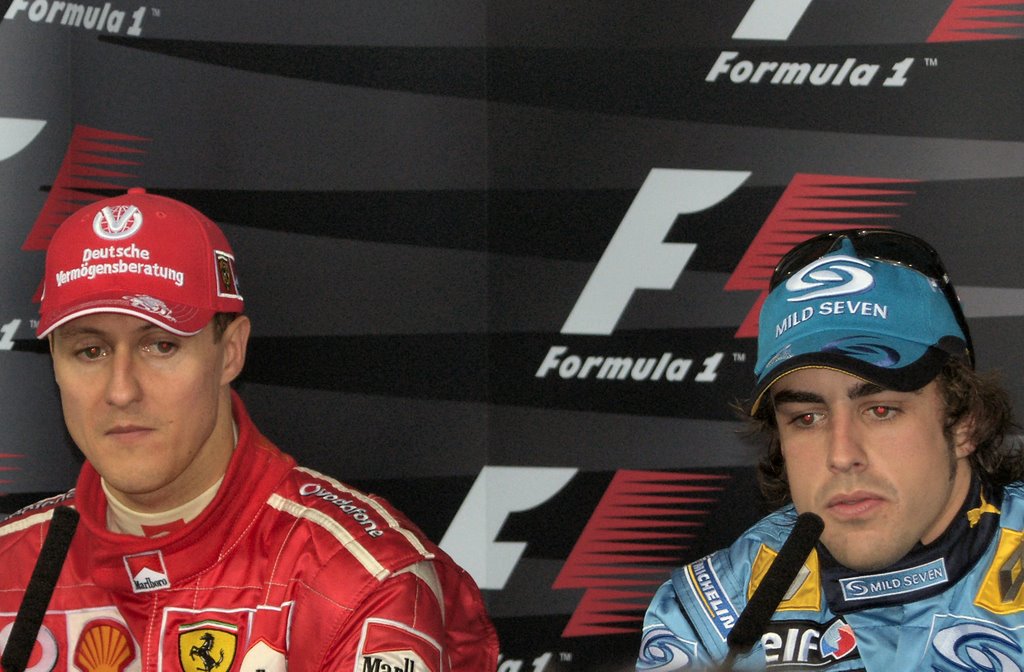
But Renault looks to be sitting pretty at this early point in the season, which is more than can be said for Ferrari who had a disastrous weekend. The Ferrari camp is placing all the blame on their tyres for the events at Melbourne (where have we heard that before?) – but in reality it is clear that the Ferrari team has a lot of work to do before San Marino on 23rd April. In Bahrain Michael Schumacher admitted that he was surprised to be on pole - and then to have finished a close second to Alonso on race day. Perhaps he knew that the car was no match for the Renault and certainly since then things have slipped away. Schumacher, like all great champions in any sport, is not the best of losers and at the age of 37 he is unlikely to be motivated to fight with an uncompetitive car throughout the season. But yesterday there was no questioning Schumacher’s determination to overcome the fact that his Ferrari was underperforming - and it was this which eventually led to his crash on lap 33. Even the greatest driver in F1 history cannot make a car with such terminal tyre problems perform.

The 2006 Formula one season is shaping up to being one of the best in recent times. Although Alonso has a comfortable lead at the moment there is now a three week gap which all the teams will be using to try and evaluate what happened in the first three races, and to try and get improvements by the beginning of the first phase of European races at the end of the month. For Ferrari there is a worrying sense of Déjà vu with many of the elements of the 2005 (not least difficulties with tyres) recurring again. The Toyota of Ralf Schumacher performed well in Melbourne to finish third, despite the fact that his car (like the Ferraris) was running on Bridgestone tyres. There will no doubt be much discussion in coming weeks between the Ferrari bosses and their tyre supplier about this curiosity! There will also be much soul searching at Marenello about the performance of Felipe Massa who managed not only to nearly write off one car in qualifying but repeat the trick in the race itself. We saw at Bahrain that Massa is a quick and skilful driver, but we also now have ample evidence that his talent is mercurial and that he is more likely to leave his car piled up in a circuit fence than he is to get it to take him to a podium.

The Australian Grand Prix confirmed Fernando Alonso’s talent, showed that Michael Schumacher still has fight in him, and revealed that we can add the Toyota team (who had a good weekend) to those of Renault, McLaren, Ferrari and Honda as possible Grand Prix winners this year. Things are hotting up nicely!

Monday, March 20, 2006

Paddy's Sports View 20th March 2006


from the "Bahrain Tribune"

Cricket fans watching matches on television should be used to it by now, of course, but that doesn’t make it any more acceptable. I refer to that common practice of commercial broadcasters (is there any other sort these days?) of using the fall of a wicket for an extended advertisement break. Wickets fall roughly every thirteen overs in a Test match, on average, so one per hour is about what you expect. A pretty rare event and therefore worth treasuring, you might think. Modern technology allows a highly technical analysis of the fall of the wicket, and TV companies employ experts in the commentary box to personally evaluate the footage. A sacrosanct moment then, sufficiently rare and important to merit uninterrupted transmission? But no, because the fall of a wicket is just the moment that the advertisers are waiting for, and the TV rights holder wants to maximise their returns, so that is the moment that we cut to the ads and by the time we return to the live transmission the new batsman will be taking guard.

Some TV companies in some parts of the world are worse than others in their commercial exploitation of cricket coverage. India is bad, and sure to get worse as the new rights holder (who paid over $US500m to the Board of Control of Cricket in India [BCCI] for the rights for four years) attempts to recoup their outlay. The time when ads were only between overs or at the fall of a wicket may seem soon like the golden days. To get a flavour of what it may soon be like let me cite the recent re-broadcast of the amazing South Africa v Australia One Day International in Johannesburg. Having missed the original live broadcast I sat down to watch the re-broadcast yesterday on ESPN (I am in India at the moment). As the climax of the match approached the ad breaks got more frequent and longer. With ten overs to go in the Proteas run chase it seemed that the action and the advertisements were roughly 50/50. It was unwatchable and I turned it off – and remember there are few more fanatical cricket fans than me, and this was one of the greatest games of cricket ever. I’ll buy the DVD!

When commercial considerations dominate then everything else is secondary and cricket in India is entering a period when it is the declared intent of the new masters of the game at the BCCI to exploit the commercial potential of the sport to the full. It all makes the much criticised sale of TV rights in the UK to satellite broadcasters Sky very small beer by comparison. The BCCI will want not only to allow their commercial partners to maximise their returns with advertising and promotion dominating TV coverage, they will also wish to ensure that every match that India plays fully exploits its commercial potential. And they certainly won’t want the international team to play matches that few in India will want to watch.

These dramatic changes will mean not only that the power has shifted away from the ineffable International Cricket Council (ICC) (their own fault entirely) but that it is now in the hands of a body that makes judgments solely on the money earning potential. One Day matches against Pakistan (the biggest of all money spinners) will take place frequently in any venue that can offer a big Asian population to fill the ground and a time zone that works well with peak viewing on the sub continent. This is (incidentally) a model pioneered by my old friends in Sharjah, and whilst the BCCI will take this to a new level, it is the Sharjah model that they will use. If the ICC sanctions the matches and gives their blessing that is fine. But if not they know what they can do!

So the fixture list so beloved of the ICC will be torn up and India will call the tune. The Indian viewer will see more of their beloved team and more of that team against the bigger beasts in the cricket world (especially Pakistan). And TV coverage will be like an electronic souk in which the golden jewels of the cricket will be visible only if you plough your way through the detritus of all the shoddy merchandise that will be so vulgarly on display.


Thursday, March 16, 2006

from the "Cricket Statistician" Spring 2006

I have every sympathy with Bob Harragan’s cri de cœur in Issue number 132 about the inadequacies of the process by which the status of international matches is currently determined.

Those of us with long memories (and I suppose that that is nearly all of us) will recall the controversy in the 1970s over the status of the 1970 England v “Rest of the World” “Test” matches. In 1971 Norman Preston announced in Wisden that he had never regarded the matches as anything other than “proper Test matches” and regretted that “… a small minority have sought to have these splendid matches omitted from the records”. True to his word Preston required that the matches be included as Tests in the records in the 1971-1979 almanacks, and his records Editor Bill Frindall duly obliged. But in 1980 Wisden finally came in line. “Much against my will,” said Preston announcing that he had had to bow to the ICC’s ruling (made in 1972) that the matches “were not official Tests and should not be included in Test match records”.

The point of recalling this story from the rather distant past is to show that there is nothing new about disputes about Test match status, but also to show that the issue had (or so we thought) been resolved. When the ICC, Wisden and others deliberated about the 1970 series there was no precedent that they could call upon so a principle had to be established. Wisden, and some others, took one view but the ICC ruled against them and whilst it took Wisden a long time to agree eventually they did. What is clear from a review of this history is (a) That there was absolute sincerity on both sides of the argument and (b) That commercial considerations played no part at all.

Rolling forward to the year 2005 we again have a match between a Test nation, Australia, and a scratch side comprised of players from other Test nations (just as in 1970). In Douglas Miller’s note on the subject in edition 130 of the Journal we have his report on the ICC’s invitation to the ACS to “comment on the wisdom of granting recognition” to this “super Test” and the ACS’s subsequent advice that Test status should only apply to a “match between two nations”. But, he says, “Our representations did not win the day”.

The matching of the ACS, honourable guardians of the integrity of cricket records, and the ICC, an organisation which in Nasser Hussain’s words[1] is led by a man, Malcolm Speed, in whom Nasser “never detected an interest in the spirit and future of the game” and for whom “the priority was always money”, was an unequal match. Douglas reports a “pleasant lunch” with the ICC’s Jon Long and welcomes David Kendix’s (ICC consultant) involvement with the ACS and hopes for a “more fruitful working relationship with the ICC in future”. A forlorn hope I’m afraid Douglas! We must face the reality born out by the facts of this debacle. The ICC was going through the motions in its “consultations” with the ACS and it is abundantly clear that they were never going to change their minds about the status they wanted to accord to the “super Test” (and to the ODIs of course). They were selling the match as a Test match to sponsors, players and the public at large from the start. Without that status it was no more than an exhibition, and, therefore, of far lower commercial value.

Douglas Miller’s forecast that it would be a series “where the players will really earn their spurs” and that it would be a “truly competitive series of matches” proved, as we now know, to be far from the mark. But that is not the issue. The issue is that if the body that arbitrates over the status of international matches is the same body that has a vested interest in selling them, then commercial considerations will always prevail. Precedents as clear as the one from 1970 will be ignored and bodies such as the ACS will be patronised. Bob Harragan is right - there must be a separation between commercial matters (on the one hand) and status/records issues (on the other). The ACS must not be trampled over by the ICC whose modus operandi and motives conflict so much with the principles which it is our duty to uphold.


[1] “Playing with Fire” Nasser Hussain, 2004

"The Wisden Cricketer" April 2006


ICC all about money
(Letter in “The Wisden Cricketer” April 2006)

SCYLD BERRY lands a few gentle blows on the ICC ("Organisng Chaos" TWC March) but his conclusion that the Council’s “achievements… outnumber its defects” is an assertion that few people would agree with.
The awarding of official status to the absurd Super Series match in Sydney brought cricket statistics into disrepute. The continued lack of sensitivity and lack of moral authority over Zimbabwe shows that the mission to ‘protect the spirit of cricket” is phoney. The insistence that the terminally weak Bangladesh and Zimbabwe teams are worthy of Test status distorts the international calendar and leads to too many grossly uncompetitive matches.
For those cricket lovers looking for a common theme which links the ICC actions TWC associate editor Nasser Hussain gave it in his excellent autobiography. Writing of Malcolm Speed, Nasser says: I never detected [in Speed] an interest in the spirit and future of the game ... the priority was always money”.

Monday, March 13, 2006

Paddy's Sports View 13th March 2006

from the "Bahrain Tribune"

Just occasionally in sport something happens in an event which has consequences way beyond the event itself. In cricket Australia, under Steve Waugh, changed the face of Test cricket with their four runs (or more) an over innovation that some other Test sides now adopt (notably by England at Edgbaston last year when their 407 runs in 79 overs on the first day took the fight back to the Aussies after the Loss of the first Test at Lord’s). Sunday’s astonishing events at the Wanderers in Johannesburg may well be a similarly watershed moment for cricket.

Twenty20 cricket has showed that it is possible to score at eight or more runs an over for twenty overs without any artificial restrictions being placed on the bowlers or fielders. The 872 run feast in Jo’Burg has shown that it is also possible, on a good wicket, to maintain this pace in the longer version of the game. I imagine that Graeme Smith’s talk to his team after they had been hammered all around the park by Australia and conceded a record 434 runs went something along the lines of “If they can do it, then so can we!”. His team believed him, and self-belief in sport is everything. I would have said that it was impossible to score 434 runs in 50 overs against a side with bowlers as good as Ntini, Hall and the rest. But Australia had done it - so the Proteas thought that they might as well try and do it as well. And they succeeded – good for them!

Whilst Twenty20 may have been the model for Australia and South Africa’s approach at The Wanderers oddly the format may be the casualty if the events do set a new trend for the traditional one day 50 over game. Who needs Twenty20 if similar excitement can be generated over the course of a full cricket day? I like cricket in all its forms (I’ll happily watch kids playing in the street using a drinks crate as a wicket) but I am not a big fan of Twenty20. There is an artificiality to it which is jarring and the matches do seem rather trivial - fun but lightweight. There was nothing lightweight about Sunday’s Fifty50 extravaganza. Hectic it might have been, and the bowlers of both sides may now be in therapy, but it was certainly proper cricket.

The proposals for a Twenty20 world cup have not been welcomed by all the members of the ICC – India is against the scheme and I think that they are right. That One Day Internationals had become at times a bit predictable, even dull was true, but the Australians and the South Africans have now crated a new ODI paradigm. How long before the first commentator says something like “India only need eight an over to beat England in the ODI at Goa, this should be well within their capability!” My football team has the motto “Audere est facere” which means “To dare is to do”. Not a bad motto for a team in any sport. The South African’s dared on Sunday – and they didn’t half “do”!

Monday, February 27, 2006

Paddy's Sports View 27th February 2006

From the "Bahrain Tribune"


The expression "home advantage" is one commonly used to describe the benefit that a team or individual sportsman has in playing on home territory; it was never more visible than in Edinburgh last Saturday. Scottish Rugby's stadium has been dubbed "Fortress Murrayfield" in the past to signal just how hard it has been for visiting teams to win there. The fortress's defences have been breached rather often in recent times with Scotland's international team going through a long bad patch. But no more. With successive wins against France and England (the most fancied sides in the 6 Nations championship) the fortress has been rebuilt and Scottish rugby fans can sing again about sending the opposition "homeward tae think again". These words from "Flower of Scotland" refer to one of the Scots proudest days when King Robert the Bruce defeated the English Army under Edward II at Bannockburn in 1314. It was Edward who was the first invader to be sent home to think again!

The English rugby team has suffered the fate of Edward fairly frequently over the years but since 1990 (Scotland's "Grand Slam" year) wins against the Auld enemy have been harder to come by. Before Saturday Scotland had only used their home advantage to get a win once over these years - on a very rainy day in 2000 when they handled the wet ball better than the English (who, of course, complained that the conditions were against them!). There were no such complaints last Saturday for although it was very cold indeed (I was not the only spectator shivering in his seat) it was dry and clear; ideal, you would think, for the handling game. Strange then that this was a match without tries - a rarity in the modern game. Both defences were excellent but the Scots were truly heroic as they repelled proud Corry's army over and over again. Despite the lack of tries it was one of the best rugby matches I have ever seen, and the Scots deserved their win.


A passionate and noisy crowd fired the Scottish players up and this support undoubtedly contributed to their success. As usual a few ill-mannered Scots nationalists stayed seated through the National Anthem (see photo) but whether this, or the pre match show put on by the Scottish Rugby Union (SRU) also helped their team I am not so sure. With kilts swirling and pipes playing we were treated to all the usual razzmatazz of Scottish national fervour. The SRU really pulled out the stops this time because we also had a "tribal Scottish perfomance" in the pre match build up with echoes of Bannockburn and Robert the Bruce (no doubt Rob Roy, Robbie Burns and Flora Macdonald as well). There were also flame-throwers, strobe lighting displays and even the firing of an artillery field gun. The Scottish flag was paraded (but not the English) and the Scottish team was announced man by man to cheers (but you had to look at your programme to find the names of the English players). I have never been to such a one-sided pre match build up at any sporting event and whilst the England team won't have been surprised at the discourtesy shown to them, the Scottish team may have been a tad embarrassed.
Home advantage is perhaps the best evidence that much of sport is played in the head rather than with the hands and the feet. You take two teams of equal technical ability and skill but the one playing at home has a clear advantage. For example in the English football "Premiership" this year to date teams have won 50% of their home games but only 30% of away matches - indicating the extent of the benefit of playing on a familiar pitch in front of a friendly crowd. In cricket that advantage is also that pitches can be prepared to suit the home side and this goes on around the cricketing world (however groundsmen and curators may deny that they work to such instructions). It is a valuable part of sport that to "win away" is often the highest achievement that any side can aspire to. This was beyond England at Murrayfield this time around and it may be beyond them next week in Paris as well. All but one of the nine matches played in the 6 Nations so far this year has been a "home win" and it is quite possible that all the remaining fixtures will follow this pattern. In international rugby it does seem that there's "no place like home".

Monday, February 20, 2006

Paddy's Sports View 20th February 2006


As published in the "Bahrain Tribune"


When I attend football matches I usually sit in a seat that is roughly half way up one of the side stands and as close to the half way line as possible. This vantage point gives a view of the game from which the whole pitch can be seen and it allows you to see all the moves in the game clearly. When television cameras cover a match this is the position of the main camera, and it is also where the media sit. But last weekend I decided to abandon my usual position and sit on the touchline at White Hart Lane for Tottenham’s game against Wigan – and what a very different perspective of the match this gave. I was in the very front row of the lowest tier of the stand within a metre or so of the side line and the corner flag. When the action was close by I could almost touch the players and could certainly hear what they said to one another, and to the referee. When Spurs Egyptian international Mido was booked (right in front of me) he showed that he has mastered the English language (or a colourful part of it) very well since moving to Tottenham.

Sitting in a seat like the one that I had on Sunday you get no feel at all for the overall pattern of play, but you do see, of course, one or two incidents very clearly. You realise much more than you do in a more remote seat, just how frantic is the pace of the modern game. A player receiving a pass has a fraction of a second to kill the ball decide what to do with it and complete the move and it is remarkable to watch this from very close to the action. I suppose that these skills are taken for granted at the top in football but they are none the less impressive for this. There were two goals at the end that I was closest to and in each case the goal had been scored before I even realised that it was a possibility the pace was so quick. It is said that eye witnesses who are close to an accident often give completely contradictory reports of what they think that they have seen, and it is the same in sport. You can be too close to the action.

The other difference in sitting in a seat so close to the pitch is that you feel much nearer to the other spectators as well. At White Hart Lane the noisiest supporters amongst the home fans sit in the lower tier of the South stand which was right next to where I was sitting. The word “fan” is short for “fanatic” and that word is certainly apposite for this group. They chanted right through the match led by a man with a large drum which he banged rhythmically all the time, and they were fully emotionally engaged for the full ninety minutes. The chants were rather disappointingly witless but at least they were not too insulting either - which will have pleased the club officials who put a message in the programme condemning offensive chanting. The referee (a black man) was roundly abused for many of his decisions and his parentage was occasionally questioned but thankfully none of this abuse was racially motivated. Spurs have an ongoing campaign which deplores racism in football and it seems to be effective. Less welcome is the fact that although the ground is an all-seater stadium the group of fans in the lower South stand ignore the rules about saying seated for most of the match. This is something that the stewards struggle to control (although they try) and is regrettable, not least on safety grounds.

Attending a football match and sitting in the sort of seat that I was in on Sunday is as much a social, even tribal, experience as it is a sporting. As with all tribes there are rituals which you have to obey and certain behavioural norms are required. One of the chants is “stand up if you hate the Arsenal” which triggers a pavlovian response from those in earshot. Quite what my grandfather, who was a regular spectator at both Spurs and at the Arsenal in the 1930s (and supported both teams), would have thought of this I wonder. He certainly wouldn’t have stood up when asked to – and in his honourable memory nor did I!

Monday, February 13, 2006

Paddy's Sports View 13th February 2006


From the "Bahrain Tribune"


The England cricket team has arrived in India to prepare for a three Test match and seven One Day International series. The first Test begins in Nagpur on 1st March. If we discount the matches against the minnows of Bangladesh and Zimbabwe then England has played eleven Test matches since January 2005, winning only three and India has played nine, also winning just three of them. Quite how that makes the two sides to be vying with one another for the accolade of second best Test side in the world behind Australia some may question. Admittedly England over that period has famously regained the Ashes whilst India’s only series win was against Sri Lanka who have slumped to next to bottom in the ICC’s rankings (minnows excluded). But all of this won’t count for much when the two teams square up for the first Test. Expect a fierce and fascinating challenge between two very good sides and look forward to some intriguing contests within the contests between some of the star players.

India has not played England since The Oval in September 2002 when the series was drawn. Only three of the England side in that match will line up at Nagpur (Trescothick, Vaughan and Hoggard) whilst India will probably have seven if they pick the same side as lost their last Test in Karachi (Laxman, Sehwag, Dravid, Tendulkar, Ganguly, Kumble and Khan) or eight if room is also found for Harbhajan Singh.

Harbhajan, of course, has not taken a wicket in his last three Test match innings in which he has bowled 81 overs but I would be astonished if he does not regain his Test place against England and I would expect that his spin partnership with Kumble to be the main bowling weapon for India (as it was in 2002 when they took 26 wickets between them in four matches on wickets much less favourable to spin than will be the case at home).

England prospered last summer despite facing the genius of Shane Warne and if they can master India’s spin attack in this series there is no reason why they should not get back in winning ways next month. The England batting line up is formidable and whilst they disappointed against a wholehearted Pakistan side last November they will be keen to get back into form against India. There is a good balance in the England batting line up with Michael Vaughan, Andrew Strauss and Ian Bell capable of playing anchor roles to allow the strokemakers (Trescothick, Pietersen, Flintoff and Geraint Jones) to entertain. Aside from the spinners England need to be wary of Pathan (who they will not have seen before) and Khan - but if they bat to their potential England should be able to post decent totals to give their bowlers room to attack.


For the first time since Trent Bridge in August last year England will have the excellent Simon Jones in the team to bowl alongside Harmison, Flintoff and Hoggard. This is the best fast bowling attack in world cricket and was the key to England’s Ashes success. Jones was missed in Pakistan and his return will give England a big lift. India’s strength is their world class batting line up (Dravid, Sehwag, Tendulkar and Laxman) and the battle between these stars and England’s fast bowlers is eagerly awaited. India’s batsmen do not need to lose much sleep over England’s spin bowing threat. With Giles injured England will choose from three spinners, Udal, Panesar and Blackwell of whom only Udal has played a Test match (three wickets for 277 runs in three matches).

So the two key questions in the series are how well India cope with England’s fast bowling strike force and how well England’s batsmen cope with the Indian spinners. In the last Test match to be played at Nagpur, in October 2004, India were bowled out for 185 and 200 by McGrath and Gillespie who took fourteen wickets between them in a match that was more of a struggle for the spinners of both sides (even Shane Warne) . A similar wicket on 1st March would suit England nicely!

No student of cricket sensibly makes predictions when India play with their off the field dramas usually proving as much colour as the on the field performances. But talent they certainly do not lack and their Australian coach will have a few personal points to prove against the Poms. Should be fun!

Monday, February 06, 2006

Paddy's Sports View 6th February 2006


As published in the "Bahrain Tribune"


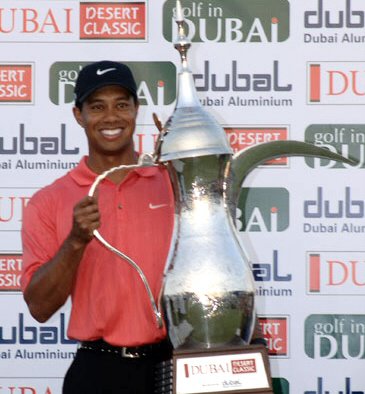
If ever there was a good example of the truth of the aphorism “Who dares wins” it was at the Dubai Desert Classic last Sunday. Tiger Woods had not been hitting the ball well off the tee all week, by his own imperious standards. His driver was not working as well as it should with too many very wayward drives getting him in trouble. True the Tiger’s short game was as solid as ever and he usually managed to recover from a bad drive with his short irons and this kept him in the hunt for a win. Reaching the 17th hole in the final round Woods was one of three or four players in with a chance. This hole is a short Par 4 (359 yards with a dog leg to the right) and for a player of Woods power the green is reachable off the tee, but it is a risky shot as Woods had already found out to his cost in previous rounds. The cautious thing to do would have been to play safe with a solid drive down the centre of the fairway, followed by an approach which would give a decent chance of a birdie. But this was not what Woods chose to do. Out came the driver and this time the contact was sweet. The ball landed on the front of the green and two putts later the Tiger had his birdie.

Some would argue that Woods bravery was cushioned by the fact that he had already pocketed a cool $3million in Dubai appearance money alone and that, therefore, he had nothing to lose by a spot of daring-do. To say this underestimates just how much the Tiger still has the urge to win. That he can command mega dollars just by turning up is a fact which he puts out of his mind when he is on the course where he has a single-minded obsession to win. When he plays a poor shot (as happened quite often last week) he doesn’t shrug his shoulders and smile but he glowers with anger and often indulges in a bit of mild club abuse as well. He is driven to succeed every time he plays not to add to the gold in his personal vault, but simply to prove again that he is the best. At Dubai he had failed twice in his previous visits and it hurt. In 2001 he had a double bogey on the final hole which cost him a win, and he had to be coaxed out of the locket room to appear at the presentation ceremony so great was his disappointment. But this year the Tiger put all that right without really, by his own admission, playing well. But he fought, and he scrambled and he dared…and he won.

Whilst Tiger Woods and Mark O’Meara (the only other American in the field) were playing in Dubai the rest of the PGA Tour were in Phoenix competing for the FBR (Phoenix) Open. Now this tournament is popular with fans and has a long history - but what a shame that it clashed with the Desert Classic. There are no less than 56 events on the PGA tour this year which means that players on the tour certainly have no need to travel if they don’t want to. Indeed it is likely that for most Americans on the Tour their only foray across the pond will be to the (British) “Open Championship” at Hoylake in July or (if they are lucky) to the Ryder Cup in Ireland in September. Most American golf fans, and even many professional golfers, are woefully ignorant of golf tournaments outside of North America (other than the “Open”) and little progress has been made in recent times to getting a more unified international professional golf calendar.

The Dubai Desert Classic is unquestionably one of the finest events in the golfing year anywhere in the world. The organisation, the course and the usually strong field make it an event that all the pros on the European Tour want to win. Surely the time is now ripe, especially given the publicity that the Tiger’s win will have generated, to recognise the Classic’s success by enhancing its status. The PGA Tour could help this by avoiding scheduling a top American event at the same time and by giving the Classic a higher profile in the media. And to have a couple of dozen players from the PGA Tour in Dubai next year might give American/Middle East relations a bit of a much needed boost as well!

Monday, January 30, 2006

Paddy's Sports View 30th January 2006


As published in the "Bahrain Tribune"


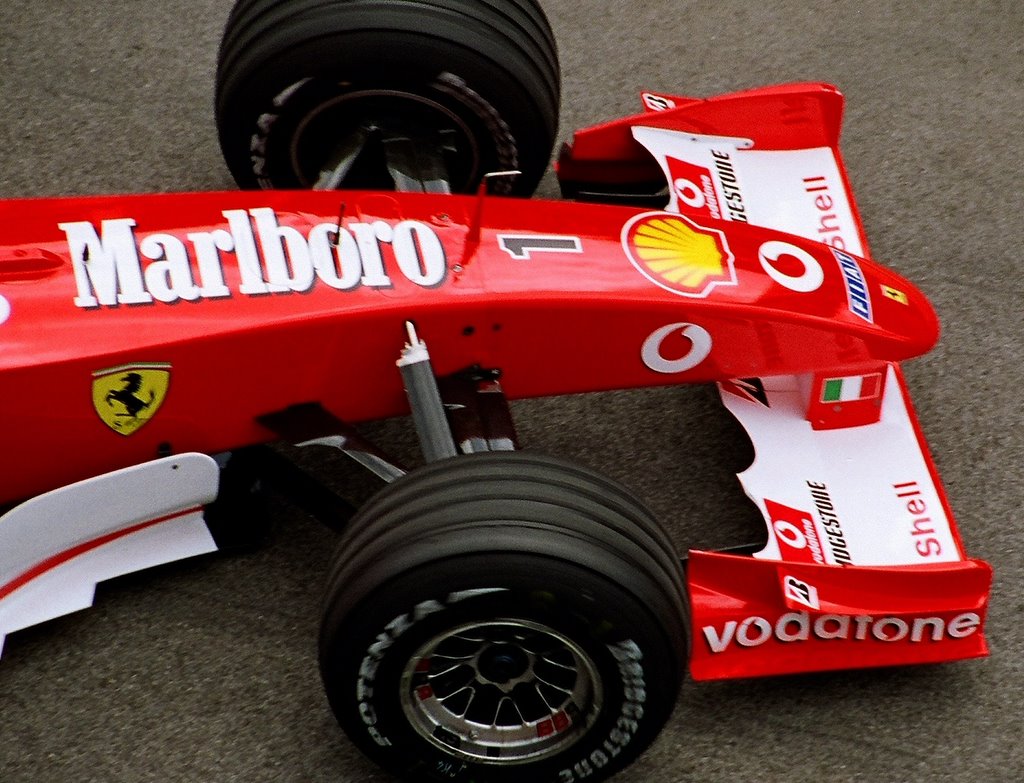
This is the time of the year in Formula one when the phoney war is underway with “new cars” being rolled out for the media at high profile events. The sponsors love it, of course, as the press and TV usually show the new cars with the sponsors’ logos prominently on display! But we haven’t in the past learned much about what is really going on. This year, however, we do at least have cars that will be radically different from the 2005 models because the car technical regulations have changed with the most significant alteration being that engines size has been reduced from the previous 3-litre V10s to 2.4-litre V8s. The FIA says that the aim is to “reduce costs and improve safety” and that this is “likely to add around three to five seconds to lap times at most circuits”.

All the teams will have been working hard to in the short time that they have available between the end of last season (16th October 2005) and the first event of the 2006 season in Bahrain on March 12th. For Ferrari it is no exaggeration to say that this is a crunch season and that a good start is essential. It is difficult to learn much from the Scuderia’ s public pronouncements but Michael Schumacher was realistic when he said that whilst his initial impressions of the new car are positive there is much work still to do before the first race. In 2005 Ferrari was overtaken by both Renault and McLaren but whether the principal cause of this loss of competitiveness was their problems with the Bridgestone tyres, or whether there was a more comprehensive slippage technically is still not clear. There is also (whisper it softly) the probability that Schumacher is not quite the driver he was, certainly when compared with Fernando Alonso and Kimi Raikkonen who are respectively, thirteen years and eleven years younger than the German maestro.

Formula one is by far the world’s most complex sport – not just the technical rules but the “sporting regulations” (a mere 35 pages) can be a minefield through which the teams must pick their way in order to ensure that they comply. I would not be surprised if the extent of the changes this year means that we have some early disputes and even disqualifications as some teams try and get an edge by interpreting the regulations in their own ways. Ferrari’s experience might be a telling factor here and their cosy relationship with the sport’s administrators may help as well. Certainly Ferrari has nothing to complain about in respect of both the timing and the nature of the 2006 rule changes. In particular the fact that in race tyre changes will again be permitted this year favours Ferrari and will have helped Bridgestone get their tyre package more competitive for this year.

All things are never equal in Formula one; there are too many variables at play for the overall performance of the top teams to be predictably similar. The margins between success and failure are so minute that one team’s car can be the equal of another’s in all respects except for one. This is where the “driver factor” plays a crucial part and where, in the past, Michael Schumacher has made the difference. He has won races and even championships in a car that was sometimes not (quite) the fastest or the most reliable, and he has performed better than anyone else in difficult race conditions - especially when the circuit is wet. But last year even he could not find a way to compete with Renault and their brilliant driver Alonso and it must be the Spaniard who is again the favourite this year. But never write Schumacher off. The best driver of all time was first world champion at the age of 25 in 1994 and it does seem that he still has the self belief that he can still hack it with the new much younger stars. History suggests that age need not be a barrier (Alain Prost was 38 when he won his last championship and Nigel Mansell a year older when he won his in 1992). If the Ferraris are the technical equal of the McLarens and the Renaults this year we will have that most delicious of sporting contests between a “good old ‘un” and a couple of “good young ‘uns”, a mouth-watering prospect!

Monday, January 23, 2006

Paddy's Sports View 23rd January 2006


As published in the "Bahrain Tribune


There is an established tradition that the major international sporting tournaments take place at four yearly intervals. This no doubt originally stemmed from the modern Olympic Games which (since 1908) have been celebrated every four years (except when wars have intervened). The first football World Cup was in 1930 and has also followed the four year gap principle, as has been the case for Rugby, and Cricket has also now settled into this pattern. Other international tournaments fit in with these schedules (in Football, for example, the European Championship) which means that sports fans will have at least one big tournament every year and also that the organisers of these huge sporting festivals have time to get everything in place. But there is nothing cast in stone about a quadrennial pattern for sport and it may be that for cricket it is time for a change.

This column has commented on the problems that the International Cricket Council (ICC) is currently having with Indian cricket, problems which, it is fair to say, are mostly of their own making. One of the things that the Board of Control for Cricket in India (BCCI) is concerned about is the ICC’s percieved need to fit in an “ICC Champions Trophy” whenever it can. This “Turkey of a tournament” (as Wisden has called it) has been beset with problems from the start and it is not surprising that the Indians want to get rid of it for good. They are right to do so.

The BCCI’ s main gripe with the ICC is that not only are they being forced to play too many meaningless matches against weak opposition but also that they are expected to commit their One Day team to largely worthless tournaments (like the Champions trophy) at the ICC’s behest. The BCCI wants more control over their own fixture list, an ambition that most of the top cricket nations will share.

On one thing, however, the ICC is right and that is that there does need to be a structure to international cricket fixtures. Not the structure that they currently have in place, for sure, but some sort of structure. For Test matches there is a need to achieve a balance between the money spinning series (such as the “Ashes” and other series in England against the top nations, the India v Pakistan matches and the Border-Gavaskar trophy) and those Test matches which do not generate huge revenues (most of the rest). And, of course, there is a need to have the big money One Day matches in some sort of arrangement which, whilst establishing a regular schedule for contest between the top nations (e.g. India v Australia), also allows the smaller nations the chance to play against the best.

The ICC’s affection for the “Champions Trophy” is because this tournament is their only significant source of revenue (which comes mainly from sponsorship) other than the Cricket World Cup (also the ICC’s property). So to continue to finance their development programmes (not least the planned cricket academy in Dubai) they need to keep the cash coming in. How can they do this and also re-establish an effective working relationship with the BCCI and other national cricket boards? Well they could start by rethinking the scheduling of the Cricket World Cup.

If the cricket world thinks out of the box for a moment then they should see that there is nothing sacrosanct about the quadrennial programme for the World Cup. Just because other sports follow this schedule that, in itself, is not a reason for cricket to do so. If the “Champions Trophy” is abolished, as surely it must be, then why not play the World Cup more frequently? Every two years would be too often and devalue the tournament, but why not schedule it to take place every three years? From the ICC’s commercial perspective this would mean that over time they would increase their revenues substantially and sponsors would be delighted that their brands are on display at a meaningful tournament more frequently. The smaller nations would welcome the chance to compete at the top level on a more regular basis. And public interest would be held because the World Cup clearly matters, whereas other more artificial tournaments matter less. It would also mean that the tournament came round to all the main cricket nations rather more frequently than at present.

Monday, January 16, 2006

Paddy's Sports View 16th January 2006


As published in the "Bahrain Tribune"


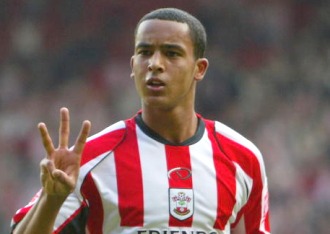
Theo Walcott is a young footballer presently playing for the English club Southampton who is seen as having extraordinary promise. Like the teenage star Wayne Rooney before him Walcott will be a multi millionaire well before he comes of age in two years time. Indeed his financial future will be secure long before he has actually achieved anything in the game as the big clubs (with Arsenal the favourite) compete with one another to sign him. The deal they offer will comprise a huge transfer fee to be paid to Southampton and a salary package for the young man which will ensure that he need never worry about money for the rest of his life (even if his football promise is not a reality when he has to perform at the highest level).

It would be churlish not to wish Theo Walcott well. But I can't help feeling that rewards should somehow be based on performance rather than potential. Remember that Henry Ford once said that you "Can't build a reputation on what you are going to do". Promise has to be fulfilled to be a reality. The same debate could be made around another British sports star the Formula one drive Jensen Button. Button is rich beyond the dreams of avarice and yet these riches have been acquired not because he has been a great driver, but because teams managers think that he might one day be one. Remember that Button, now in his sixth season in Formula one, has yet to win a Grand Prix!

Perhaps I have an over puritanical view that reward in life should be a reflection of achievement. In the world of professional golf, for example, where there certainly have been some examples of players who have got rich on promise rather than success, in the main pros have to work very hard (and be very good) to achieve the mega money being thrown at Walcott or Button. If you look at the prize money at an average PGA event you will see huge prizes for the top five or six finishers. But go down the list and you will notice that even if you make the cut in most events you are not really even guaranteed a prize that will cover your costs. Play badly in any one week and you don't earn anything. The journeymen pros on the big tours in the USA and Europe can make a decent living out of the game, but they usually need one or two top five finishes every year to prosper. The same applies in professional cricket. Play regularly in an international side and you will make good money (and if you are an icon like Tendulkar, Lara, Warne or Flintoff very good money indeed). But your average pro in the County or the State game is likely to be paid very modestly indeed - they really do often play for the love of the game, not its rewards.

It is naïve to think that in the world of today's professional sport money matters are not all pervasive. Too often the actions of sporting administrators, competitors and teams are in stark contrast with the moral principles of the sport. In recent times we have had the illegality of drug abuse, match fixing and cheating in too many case to mention. And we have also seen too often unbecoming on the field of play behaviour by multi-millionaire stars (abuse of opponents, challenges of officials). But when we charge these miscreants with bringing their sports into disrepute (which they do) should we not also be looking at the actions of those who allow conditions to be created within whom these abuses can occur? Many sports have created reward systems which involve so much money that, whilst this does not excuse inappropriate behaviour by players, it does explain it.

Rewards should be more closely linked to performance, rather than promise, and the penalties applied to those who break the rules should be more stringent than sometimes they are. And those who administer sport should behave rather better themselves! Then we might have a world in which sports and sportsmen would set a better example to young people than that set by a foul-mouthed millionaire teenage footballer, a perfomance-enhancing drug taking athlete or a cheating cricketer claiming a catch when the ball has grounded.

Monday, January 09, 2006

Paddy's Sports View 9th January 2006

As published in the "Bahrain Tribune"


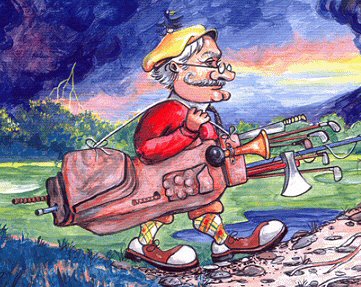
I am not sure whether those clever people who study human DNA have found the sporting gene, but I am sure that it exists. It is that part of every individual’s genetic make up which determines their sporting prowess and, like most aspects of human ability, it is present to a greater or lesser extent in all of us. I have been thinking about this phenomenon recently in relation to the game of golf (and my continued pathetic attempts to reach even a respectable level of proficiency). I have come to the conclusion that it is all very unfair because those lucky people who have the gene can apply it to almost any sport. So good cricketers and tennis players are almost always good golfers and so (rather less logically) are good footballers. And those of us of more modest sporting abilities are modest at every sport we try - if only (we think) we good be good at just one sport that would be fine! But whether it is golf club, cricket bat, tennis racquet of football we can’t really hack with any of them!


Will, an old school friend of mine, has the sporting gene in abundance – he was effortlessly good at every sport he tried. I saw him again after a gap of many years quite recently at a corporate golf day. Now Will has always been a bit of an eccentric with what, I think, we now politely refer to as an “alternative lifestyle”. He is rather good at not conforming and it is always amusing to see what his latest minor rebellion against convention will be. At the golf day, held at rather a snooty Home Counties golf club, Will arrived in the car park astride a large and very noisy Harley-Davidson! Now the quick thinking amongst you will notice a potential problem with this mode of transport – it is not ideal for carrying your golf clubs! Whilst the remainder of us were unloading our clubs, trolleys and other equipment from the boots of our saloon cars we noticed that Will had a rather dirty canvas bag slung over his shoulders on the bike. On closer inspection the bag contained a putter, a wooden driver of uncertain vintage, a wedge and a couple of other ancient irons with hickory shafts. They were all about fifty years old, or more.


On the first tee three of us took a few practice swings with our state of the art Callaways, Taylors and Pings before hitting drives of varying degrees of ordinariness down the fairway (or in my case into the rough). Will then took his ancient driver from his grubby little bag and hit a drive of unerring accuracy two hundred and seventy yards down the fairway which he then followed with an exquisite wedge shot hit high into a bright blue sky from which it descended 6 feet away from the hole for a birdie.

The moral of this tale, of course, is that in golf talent will always out and the equipment doesn’t really matter that much if you have talent in abundance. This fact doesn’t stop even the top professionals from trying new equipment which might give them an extra yard or two or help them cope better with a touch of jitters on the green. But most pros could regularly break par with a bag of clubs like my friend Will’s and with an old rubber-core ball. This brings me to the subject of golf ball technology and the detrimental effect that advances are having on the professional game.

In 1980 the leading driver on the PGA tour hit the ball an average of 274 yards. In 2005 the top driver averaged 319 yards with money leader Tiger Woods in second place with 316 yards. The golf ball is, of course, only one of the factors in this increase but it is increasingly becoming one of the most important. Manufacturers now have a far greater understanding of golf-ball aerodynamics than in the past and they are able to use this knowledge, combined with new materials and manufacturing methods, to make balls which go further and further. Good news for the good amateur perhaps (although for the hacker like me it could mean only that my ball goes further into the rough). But is this really desirable in professional golf where golf courses regularly have to be lengthened to cope with these changes?

Monday, January 02, 2006

Paddy's Sports View 2nd January 2006


As published in "The Bahrain Tribune"

I am unlikely to be an apologist for, or a natural supporter of, the Board of Control for Cricket in India (BCCI) described in the 2005 Wisden as one of the “worst [cricket] administrators in the world”. But with the departure of Jagmohan Dalmiya and the accession to power of Sharad Pawar and Lalit Modi it does seem that the Indian cricket scene is changing very rapidly. One of the consequences of this is that the International Cricket Council (ICC) will be in for a hard time as the BCCI flexes its muscles and challenges their authority. This can only be a good thing.

The substantive issue which has raised the temperature between the BCCI and the ICC is the international fixture list; the BCCI wants greater control of when and where the Indian team plays. They want fewer meaningless fixtures against the minnows of Bangladesh and Zimbabwe and more lucrative matches against the top cricket nations. Bilateral talks have already taken place with Cricket Australia and are planned with the English Cricket Board and others.

To understand the underlying factors behind these developments we need to comprehend why the ICC is worried, it is all about power and money! Although superficially the ICC is all powerful in world cricket in reality this power is built on very shaky foundations. In essence the ICC owns the Cricket World Cup, but very little else. Virtually all of the ICC’s income is generated from sponsorship of the World Cup which is why they keep such a tight control of this tournament and its exploitation. It is also why the ICC promotes other events to try and augment the income stream from the World Cup. These events have been unmitigated failures. The ICC Champions Trophy was described by Wisden as a “Turkey of a tournament” and as one of the “Great Sporting Fiascos of our time”. Similarly the ICC’s other event, the so-called “Super Series” involving Australia and a Rest of the World team, was a disaster with poor crowds and lousy one-sided cricket.

The ICC’s other big idea is their “Test Championship” and “One Day Championship” tables. These tables purport to show the rankings of all the international teams in Test matches and One Day cricket, but it is only the ICC who sees these tables as anything other than mildly interesting. When England played Australia last summer they were not playing to improve their positions in the ICC’s table, they were playing for the Ashes. Similarly when India plays Pakistan later this month it will not be the effect of the results on their position in the championship tables that will be uppermost in the teams minds! Any table of this sort is going to be arbitrary - change the rules and you change the positions. The tables are not valueless, but they are a consequence of results not the driver of them. The ICC’s affection for its tables is partly because they seek to make sponsorship money from them and partly because it allows them to try and dictate fixture schedules. And this is the nub of the problem between the ICC and the Indian Board.

The BCCI in its new guise has realised just how powerful a product Indian cricket is. Lalit Modi has called it the “number one sports brand in the world” and the “number one sponsored team across all sports”. Given this they want control over when and where India plays and they don’t want the ICC interfering by trying to make them play meaningless fixtures against weaker teams at inconvenient times and with low income generation potential. There are risks inherent in what the BCCI is trying to do, not least the danger of lower interest Test cricket being pushed aside to allow more and more One Day Internationals to be played, but the BCCI has a strong case. Last year India played 21 ODIs but of these a ludicrous 10 were against Sri Lanka and a further 5 were against Zimbabwe and New Zealand in the meaningless Triangular series in Zimbabwe. Not one ODI was played against Australia, Pakistan or England over the whole year. Indeed India has not played World Champions Australia in an ODI for nearly two years (apart from one rained-off exhibition match in Holland). This is clearly absurd and something that the BCCI is determined to put right and if they take on and beat the ICC on this issue quite a few of us will cheer!

Monday, December 26, 2005

Paddy's Sports View 26th December 2005


As published in the "Bahrain Tribune"


It was the American genius and iconoclast R. Buckminster Fuller who said “Those who play with the devil's toys will be brought by degrees to wield his sword” and whilst it was not Formula one that was in his sights when he said it, it might well have been. The growth of modern F1 has been built on the devils toy of tobacco sponsorship and there were few more vocal defenders of the rights of the tobacco giants to promote their brands than the leaders of the sport. It is no exaggeration to say that the commercial basis of Formula one, and the billionaire wealth of its presiding spirit Bernie Ecclestone, has been mostly built on the willingness of tobacco company sponsors to allocate almost unlimited funds to the sport. But this is changing as legislation gradually takes its grip and this is one of the reasons (but not the only one) that the future of the sport is so uncertain.

When the Formula one circus begins its long 2006 trek in Bahrain in March all the participants will know that the future of the sport is cloudy, to say the least. Federation Internationale Automobile (FIA) President Max Mosley has recently bemoaned the fact that it is extremely difficult to reach any agreement with all the Team owners as to the future of the sport once current arrangements expire at the end of the 2007 season. The difficulties are directly attributable to the disappearance of tobacco company sponsors and the opportunity that this has given to the motor manufacturers to tighten their grip on the sport. When the tobacco giants ruled the roost their business case was predicated on the fact that other brand promotion outlets were being increasingly closed to them. Nobody, not even the motor manufacturers, could compete with that sort of money. Ten years ago, for example, all of the main teams in the world championship (Williams, McLaren, Jordan, Ferrari, and Benetton) were backed by tobacco dollars. The involvement of car companies was only as the supplier of engines, not as prime sponsor. In the 2006 season five of teams are in business overtly to promote a motor manufacturers brand (Mercedes, BMW, Renault, Honda and Toyota) and the independents are in decline. From ten years ago only McLaren and Williams remain, and it is clear that the former is more and more a works Mercedes team. Ferrari, as ever, remains a special case!

In many ways you might think that the increasing involvement of motor manufacturers in F1 has to be good for the sport, after all those with very long memories will go back to the days when most of the teams were car companies, albeit rather special ones (Alfa Romeo, Ferrari, Maserati, Mercedes, Lancia…). The difference is that today the sport is so international and so visible that it is primarily a vehicle (no pun indented) for the big car companies to promote their brands. And the funds that they allocate to this almost defy belief. Some of the constructors have budgets in excess of $400 million for 2006 and this is the sort of money that is not sustainable in the longer term and which is a huge barrier to entry to new teams. Whilst the new “Midland” team may also have plenty of money from its Russian owners they, and the other remaining independents (Williams, Red Bull and 'Super Aguri') have little chance of securing many points in 2006.

The FIA is struggling to sign up teams to their preliminary proposals for a new agreement to take effect from the 2008 season largely because the motor manufacturer teams won’t play ball and continue to threaten to set up their own championship. Recent events have shown that the propensity of these car company teams to throw money after success has not declined. Fernando Alonso did not leave Renault for any other reason than that he was, quite literally, made a financial offer that he could not refuse (and who could blame him?).

The position of Ferrari amongst all these power struggles is interesting. They are signatories to the FIA’s proposals, and this suggests that they are not really willing to continue to provide unlimited funding. In recent years Ferrari has been the best financed F1 team, but their owners (Fiat) get no brand value from Ferrari’s presence and the economics of allocating F1 costs to their luxury Ferrari car brand don’t stack up. Like the independents it is in Ferrari’s interest to have a rather leaner F1 model in the future.

Wednesday, December 21, 2005

Sports review of the year 2005

As published in the "Bahrain Tribune"


We sometimes forget that every sportsman or woman who earns a living as a professional is quite exceptionally good at their sport. Even the humblest of journeymen pros on the PGA tour, or the man who “just” plays cricket for his county or state, or the footballer in the lower divisions of a league is hugely talented by the standards of ordinary mortals. Watching Arsenal versus Chelsea last weekend it was no surprise that every player on the park could trap the ball with ease and pass the ball thirty or forty metres with precision – that’s the bare minimum of what they have to be able to do to be a paid footballer! But to take them into the super star category (and every player at Highbury was certainly in that league) they have to have much more than the “basic” skills. So as I look back through 2005 and review the five sporting stars who shone most brightly during the year it is always those with that something extra which stand out.

Valentino Rossi
In 2005, at the age of 26, Valentino Rossi became the MotoGP World Champion for the sixth successive year proving beyond doubt that he is one of the greatest, if not the greatest, rider of a motorcycle that the world has ever seen. Rossi does things that other riders just don’t do. He uses his brakes in situations where if other riders did the same they would fall off their machines. He shifts his balance on his Yamaha quite differently from other riders to coax that tiny bit of extra grip or speed that makes the difference. Indeed he and his motorcycle are one unit at all times and this relationship owes more to the Arts than it does to Science. You could not do a scientific model of Rossi’s skills because they transcend the mundane input/output mechanics that science requires. Rossi is Mozart, not Newton.

Fernando Alonso
When Fernando Alonso won a Grand Prix for the first time in 2003 he was only just 22 years old, an almost Valentino Rossi like precocity. And like Rossi it was soon clear that Alonso was a driver with that extra quality that was likely to place him amongst that small number of Formula one greats. But for Alonso to succeed ahead of Schumacher, or Raikkonen or Montoya in 2005 he had to have a reliable and quick vehicle on which to perform. When Renault delivered such a car there was, literally, no holding the young Spaniard back. Alonso was on the podium for an astonishing fifteen of this year’s nineteen Grands Prix and he won seven of them. We will have an opportunity to see the extent to which Alonso, like Rossi, has the innate ability to succeed whatever the team when he moves to McLaren in the 2007 Formula one season. The news that Alonso is deserting Renault, who gave him his championship opportunity, is surprising and it will also place Alonso under pressure during the 2006 season. If he retains his world championship despite the understandable coldness that might be present in the Renault garage it will be an even greater achievement than his 2005 win.

Andrew Flintoff
When Andrew Flintoff first burst on the cricket scene at international level in 1998 it was obvious that here was an all round cricketer of exceptional natural talent. But it took quite a time for him to break through and many of his early England appearances were characterised by short cameo innings and the occasional wicket taking delivery, but not by any consistency or sign that he had a real cricket brain. He also found it difficult to keep fit and injury free and (as the Australians called it) “tubbed up like a pot of lard”. But over the last couple of years “Freddie”, under Duncan Fletcher’s guidance and Michael Vaughan’s leadership has become the outstanding all-rounder in world cricket. 2005 was his Annus Mirabilis and it is no hyperbole to say that without him England would not have regained the Ashes. For all his fame and sudden fortune Flintoff is a man who is more than just a sporting star and the dominant image of the year has to be his consoling of Brett Lee at Edgbaston when England had just snatched a remarkable victory from the Aussies grasp.

Annika Sorenstam
Sorenstam had an almost Rossi like run of success in 2005 winning an astonishing eleven of the twenty-one tournaments she entered in 2005, including two majors. This was twice the win percentage of Tiger Woods in the same year (and the Tiger had one of his best ever years!). Any golfer will know that tournament victories at any level are rare and even the very best golfers would be happy with (say) two in any one season. To win eleven in the increasingly competitive world of Women’s golf is extraordinary. This success puts into context young Michelle Wie about whom much of the golfing hype has been this year. Wie is good, but has yet to really compete for victory in any tournament and she would perhaps be well advised to look at the remarkable Sorenstam for inspiration.

Daniel Carter

The New Zealand rugby fly half shares with my other players of the year that unique ability to do things that others cannot do, however hard they try. Like Rossi caressing his motorcycle Carter moves with a grace and a power that leaves others standing forlornly in his wake. Whereas other formidable All Blacks like Jonah Lomu or Tana Umaga have relied substantially on their bulk to slice open defences Carter moves his 97 kilos with the elegance of a ballroom dancer. He plays in a fine team, which helps of course, but Carter was the inspiring force which made the All Blacks unstoppable throughout the year and which also made them my sports “Team of the Year”.

Monday, December 12, 2005

Paddy's Sports View 12th December 2005


As published in the "Bahrain Tribune"

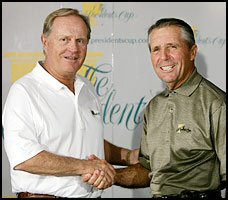
A few years ago I was lucky enough to be at a charity golf event where the two main participants were Jack Nicklaus and Gary Player. They both signed a golf cap for me which I proudly wear in the forlorn hope that some of their magic will rub off on me (it hasn’t, of course!). On those occasions when you do rub shoulders with the sporting greats (overused word, but not for these two) you get a chance to try and spot what it is that makes them different and with Nicklaus, in particular, what struck me was his powers of concentration. The event itself didn’t matter that much, but when he was at play Jack never for one moment let his concentration wander – he was focused all the time. Match that with a sublime talent to strike the ball cleanly and an absolute determination to win and you have the recipe for success.

When Jack Nicklaus walked down the 18th hole at St Andrews for the last time this year at the Open Championship there was genuine warmth in the farewell he received from everyone there. It was 35 years since his first Open win at this historic course when, at the age of 30, he was perhaps at his peak and, whilst he may walk a little more stiffly these days, and he is not the “Golden Bear” of old, he can still play a bit. If that was the nostalgic moment to savour from the 2005 golf year the main golfing story was the “comeback” of Tiger Woods. For the Tiger all things are relative and I suppose that by his imperious standards 2005 has to be seen as a return to form after a couple of lean years. He dominated the PGA tour (six victories, including major wins at the Masters Tournament and The Open Championship) and seemed back to his very best. Woods has now won 10 majors which puts him third in the all time list behind Nicklaus (18) and Hagan (11). The other Major winners this year (Mickelson at the PGA and Michael Campbell at the US Open) are also world class (unlike one of two of the “One Win wonders” of recent years). Campbell followed his first big win for a while with another at the World Match Play later in the year - a welcome and deserved return to form for this most talented of players. Expect more from the young New Zealander in 2006.

For Ernie Els the year was blighted by a knee injury that he picked up in July and he was out of competitive golf for much of the season. But once Ernie was fit again it didn’t take him too long to get back into winning ways and his win in the Dunhill in South Africa last week shows that he is swinging well again. It was the year for comebacks, and Colin Montgomerie was another who got back to form in style. If Jack Nicklaus is a master of concentration then Monty is the master of intensity. He has a face which always betrays his feelings and his thoughts and can there ever have been a more intense character at the top of professional golf? His successes this year (which led to a win in the European order of merit for the eighth time) have carried him into the world’s top ten at the age of 42, a remarkable achievement. Wearing your heart on your sleeve, as Montgomerie always has, does not always make you popular but there is no doubt that if Monty could somehow win that elusive first Major victory in 2006 it would be a very popular win indeed both amongst his fans and amongst his fellow professionals.

There was a symbolism about St Andrews this year with Jack Nicklaus playing his last tournament and Tiger Woods in unbeatable from. The mantle of champion had perhaps already been passed from Jack’s tight grasp but this year we began to see the title of the “Greatest” being passed as well. Woods elegantly referred to Nicklaus as the “Greatest” after the tournament, but it is now quite clear that the Tiger himself is not far behind. In 2006 we can expect that Woods, Els, Mickelson, Singh and (I think) Campbell will lead they money list and I hope to see these Major winners joined, if not by Montgomerie, then by young turks like Luke Donald or Sergio Garcia. The golfing year ahead looks full of promise.

Monday, December 05, 2005

Paddy's Sports View 5th December 2005


As published in the "Bahrain Tribune"


At the end of the third day in the first Test match between Pakistan and England at Multan the home side had clawed their way back into a match that seemed to be slipping away from them. Although at 125-2 in their second innings they still trailed England by 19 runs there was hope that they could bat well on the third day and perhaps get into a position to cause England some trouble in their second innings on a crumbling pitch. When the night watchman was out early the next morning the stage was set for Pakistan’s captain Inzamam-ul-Haq and he did not let his team down. He supported Salman Butt in a stand of 135, scoring 72 priceless runs off 172 balls. It was a Captain’s innings, and it set up an unlikely win for Pakistan. And Inzy continued to lead by example in the next two Tests to help Pakistan deservedly win the series.

When fine batsman become Captain in can sometimes affect the quality of their batting. Michael Vaughan is a case in point. In the 31 Test matches he played for England before he became Captain he averaged 51. In the 33 Test matches he has played as Captain he averages 36. Vaughan is a very good captain indeed, but his batting has suffered. Inzamam is the reverse. In the 88 Test he played before he became Captain he averaged just under 50. In the 16 matches he has played since being made Captain permanently in October 2003 he averages 63. He clearly relishes the challenge and, more surprisingly, has not let the cares of leadership trouble him at the crease.

Shortly before Inzy became Captain I wrote “Can there be a more enigmatic, brilliant, troubled player in any sport than the extraordinary Pakistani batsman Inzamam-ul-Haq? To paraphrase Lowell “three-fifths of him is genius and two-fifths sheer clown” and when you go to watch him play you are never sure whether it will be clown or genius that you will see”. Inzy’s performances in the 2003 Cricket World Cup (scores of 6; 4; 0; 0; 6 and 3) had been so dire that he was left out of Pakistan’s team for the England tour and one wondered whether he would ever play International cricket again. But the Pakistan selectors brought him back and soon made him Captain – it was an inspired move which took a while to blossom, but is now paying dividends.

Inzy has now Captained Pakistan to five wins and one draw in his last six Tests as Captain. Pakistan’s only recent Test defeat was against the West Indies in May when Younis Khan led the side when Inzy was injured. From the reaction of the players throughout the England series it is clear that they all revere their Captain and will do all they can to work hard for him. Even the mercurial Shoaib Akhtar and the “show pony” Shahid Afridi perform well under Inzy’s command. Even more importantly the young players who are new to the side like Salman Butt and Kamran Akmal have really progressed and look fixtures in the side.

That quite late in his career Inzamam has proved to be a skilled leader is a surprise, but that he has established himself as one of Pakistan’s all time great batsmen is not. He is more than just an “anchor man” (although he certainly can hold an innings together and he bats well with the tail). Inzy has the ability to change his style and approach in keeping with the circumstances and now that he is Captain you suspect that he takes this responsibility particular seriously. The ultimate test lies ahead when India visits Pakistan in January. There is always unpredictability about Pakistani cricket which makes fools of forecasters. That used to be the case with Inzamam-ul-Haq as well - which Inzy would come out to play? But the mature Inzamam, as proud Captain of his national side with a series win against Australia’s recent conquerors under his belt, is a different prospect. The Test series versus India will make compelling viewing, and with India in some disarray at the moment Pakistan are favourites. A convincing home series win against India might even put the recent celebrations after beating England in the shade!

Tuesday, August 16, 2005

Old Trafford Ashes Test match

As published in "The Emirates Evening Post"

Old Trafford Ashes Test
By
Paddy Briggs


Day One

After the frantic pace of the First Test at Lord’s, and the unequalled excitement of the Second Test at Edgbaston, we were back to something like normal Test cricket at Old Trafford yesterday. Modern Test cricket, that is – not the sort of grinding stuff that we used to see. There was an Ashes Test on the same ground 41 years ago when Australia scored 253-2 on the first day, and that was pretty swift for those times. Today’s Test cricket is played at a far faster pace and although England’s 341 off 89 overs at 3.83 an over was slower than we have been accustomed to in this series, it was still entertaining stuff.

The Old Trafford wicket looked firm and true, with a bit of bounce, and it was a good toss for Michael Vaughan to win. That Glenn McGrath was fit to play was a surprise, and it seemed to be a justified risk for Australia to play him as he was soon in the groove. Indeed he was extremely unlucky to finish the day wicketless with Trescothick being dropped by Gilchrist and later beating and clean bowling Vaughan, but off a no ball. Brett Lee, who spent two nights in hospital with his knee infection, was also declared fit and with 3-58 was the pick of the Aussie attack. Gillespie had another woeful day and conceded 89 runs in his 15 overs, and Shane Warne (for once) toiled a little on a pitch which offered him little assistance. Warne’s delight when he became the first bowler to take 600 Test wickets when he got Trescothick caught behind was justified and it was also good to see the knowledgeable and generous Old Trafford crowd give him a standing ovation.

If England could have selected two prizes to take from the day at the start it would have been the return to form of Vaughan and the coming of age of Bell. Both happened and, most importantly, Vaughan played as well as he did when he scored 633 runs at an average of 63.3 during the 2002-03 Ashes series. Vaughan’s overall record against the Australians is rather weird. He has been dismissed eleven times for 160 runs (average 14.5 top score 41), but in his other four innings he has scored 177; 145; 183 and now 166. He certainly looked back to his best yesterday and he will be disappointed to have mishooked a full toss from the part time bowler Katich down Glenn McGrath’s throat - a tame dismissal. Kevin Pietersen also mishooked and was caught in the same way near the close of play and he may need to limit his shot making a bit in such circumstances in future. Bell, on the other hand, was circumspect through most of the day, although a couple of lusty boundaries off Warne showed his attacking ability. He played the sort of innings that England have missed since Thorpe left the side - 59 runs off 146 balls – and he, unlike Pietersen, he will start again tomorrow.

If England can add another hundred or so tomorrow and reach a total of 450 plus then they can put Australia under pressure. But with the weather (as always at Manchester) a little uncertain, and the pitch still playing well, the outcome of this Test match might just be that rare thing a draw – but there is a long way to go.


Day Two

The true test of greatness of any player or team is not seen when they keep on winning and carry all before them on a roll, when they are in adversity. We saw how the Australians did this at Edgbaston and so nearly pulled off a sensational victory, so anyone who is ruling them out of the Old Trafford Test would be well advised to keep quiet for a day or two! But the looks on the faces of the Aussie team (shown towards the end of the day’s play on the big screen at the ground) showed how unfamiliar the “backs to the wall” situation that they now find themselves in is to most of them. At 210-7 Australia are 234 runs behind England and 35 runs short of avoiding the possibility of a follow-on.

In the run up to this Test we had the saga of Lee’s knee infection and McGrath’s recovery from his ankle problem and whilst both bowled heroically they could have done with support from Jason Gillespie in England’s innings, support which was sadly absent. A three pronged pace attack comprising two recently injured players and one dolefully out of form was hit for 300 of England’s 444. Contrast this with the performance of England’s four pronged attack all of whom were fit and raring to go. Surely the form of at least two of the four would be good and so it proved with Flintoff (as ever) - and Simon Jones sharing four of the seven Aussie wickets that fell. Significantly it was Ashley Giles who took the other three and it looks as if the pitch suits him nicely! He has 3-66 in 21 overs so far and, for once in his life, his performance can be spoken of in the same breath as that of Shane Warne (4-99 in 33.2 overs). Giles’s ball which bowled Damien Martyn was one that even the great man would have been proud of.

For Michael Vaughan the fact that he has four quality pace bowlers in his side will be a crucial factor if he does have the opportunity to force the follow on. Certainly his attack will be fresh in the morning and with the weather still a bit iffy he may ask Australia to bat again if he gets the chance. If this happens it will be Australia’s first follow-on for an amazing 17 years! If not, I don’t think that Vaughan will be too unhappy because a lead of around 200 should be sufficient to provide England with a platform from which to set Australia a very tough total to get in the fourth innings on a crumbling pitch and with Giles bowling well.

But cricket’s history is illuminated by improbable recoveries from dire circumstances (Headingley 1981 and Calcutta 2001 for example). So I’m making no predictions!

Day Three

Only 14 overs were possible at a very damp Old Trafford, but they could prove to be the most important overs of this match. Australia added fifty runs without losing a wicket, and they saved the follow on. A missed stumping and a dropped catch by Geraint Jones (both from Warne) have cost England dearly. With the confident Warne still at the crease, and in sight of his first Test century, the Aussies could significantly close the gap with England’s first innings on Sunday morning. If they can narrow the gap to what it was at Edgbaston (99 runs), which would mean a total of 345, there would be some real nerves when England come out to bat again. Can Warne and the numbers 9, 10 and 11 again add another 80 runs or so? Don’t bet against it.

Those who know Shane Warne well always attest to the brilliance of his cricketing brain. That he would be on the team sheet of the “All-time-great XI” for his unique bowling talent goes without saying. But his batting and his all round feel for the game, combined with his ebullient self-confidence, make him a more than valuable team member in other respects as well. Had his private life been a little more conventional he would probably have been Australia’s captain after Steve Waugh, but then a “conventional Warne” is not really very likely. Few would begrudge him a hundred tomorrow, providing, that is, that England can still get a lead of at least 150!

If we have two full days (the weather forecast suggests that we might) there is still time for a result in this match. England will be desperate to avoid the nail biter of Edgbaston so will be looking to set Australia at least 350 in their second innings and also leave themselves enough time to bowl them out a second time. Early wickets tomorrow, a lead of 150 and then two good session scoring around 200 runs could set England up to make inroads before the close. But Australia will be unlikely to accommodate them in this ambition and we can expect a further sting from the tail with Warne relishing the possibility of being the fourth cricketer in history to score a hundred and take ten wickets in a match (the others were Alan Davidson; Ian Botham and Imran Khan).

Day Four

One of the reasons that Test matches presents the ultimate cricket challenge is the need for Captains constantly to be reassessing their options throughout the match, especially in the field. In a one day match you pretty much know who you will bowl and when and what your field placings will be. There is some room for innovation and for conjuring up the odd surprise, but not much. In Test cricket there are few restrictions on the Captain and within the Laws of the game he can pretty much bowl who he like and when he like and place his fielders where he likes. This adds greatly to the interest that the game creates and, in modern times certainly, creates an absorbing spectacle when the two sies are evenly matched.

In the Old Trafford Ashes Test, which enters its final day tomorrow, I would award most of the captaincy prizes to Michael Vaughan who has not only led from the front with his wonderful batting in the England first innings but also showed an originality both in his filed placings and in his handling of his bowling attack that has set him ahead of Australia’s Ricky Ponting. There is also the small matter of leadership and here Vaughan also has the edge. Obviously it does help if you are playing well, as England have throughout this match, but when the heads fall it is up to the captain to try and get them up again, and Ponting is struggling to do this. When Steve Waugh led Australia there was not the slightest doubt who was in charge on and off the field. Ponting is a little less authoritative and not quite as driven as Waugh (who is?) and this has perhaps frustrated some of the old pros in the Australian team. And, Clarke and Katich apart, they are all old pros in the Australian team! So although the tabloid stories of a rift between Ponting and Shane Warne are probably greatly exaggerated there is a sense that all is not quite what it might be in the Australian camp. This shows itself on the field with sloppy fielding and at times wayward bowling, and it has shown up as well in the Aussie batting where the main contribution in recent innings has come from Warne and the tail rather than from the front line batsmen.

If Australia is to force a draw( or an improbable win) at Old Trafford tomorrow then it must come from the top line batsmen who have in the main underperformed in the Ashes series to date. It is worth reminding ourselves that five of Australia’s top six in the order in the first innings of this match (Langer, Hayden, Ponting, Martyn and Gilchrist) are in the top 17 in the ICC world Test rankings – but these players scored only 122 runs between them. It was only Shane Warne’s marvellous 90 and the back up he received from Gillespie that gave Australia a half respectable total of 301.England built on the lead of 142 with some skilful batting in their second innings - to score 280 runs at 4.5 an over was an excellent effort, with Andrew Strauss scoring a century and showing, for the first time in this series, the form that has given him such a great start in Test cricket.

Some in the Australian camp will feel that if they could be (say) 130-1 at lunch and then (say) 260-2 at tea then they could push on to a world record setting victory in what will be a long final session tomorrow. On the other hand there will be those who will think that a more realistic ambition is to bat through the day and go to Trent Bridge all square. The England camp will all believe that if they continue to play with the intensity and confidence that they have shown throughout this match then England can certainly force a win. The improbable headline in one of the Saturday papers here in Manchester was “Giles leaves Australia in tatters” (following his first innings haul of the wickets of Langer, Hayden and Martyn). Such a headline would have seemed inconceivable a few weeks ago but if it was repeated in a day’s time it would not really be a surprise - the Old Trafford pitch may give him help and he is (crucially) full of confidence.

Day Five

It was Ralph Waldo Emerson, an American and therefore unlikely to be a cricket enthusiast, who said “A hero is no braver than an ordinary man, but he is braver five minutes longer.” And that was, really, the story of the final day’s play in the epic Old Trafford Ashes Test match. The hero was the Australian captain, Ricky Ponting, who played one of the very greatest rearguard innings in Test history to hold England at bay and to create the possibility of a draw with honour. It was not that Ponting survived; but that he did it with style and that he endured until almost the end of the Final Act of the drama. The statistics of the innings, whilst impressive, are almost trivial because this was an innings not measured by the cold banality of the scorer’s pen, but in the character of the man who achieved so much. The figure tell of an innings which lasted 275 balls, which was 42% of all the balls that England bowled; they tell of an innings of 156 runs, which was 42% of the runs that Australia scored and they tell of an innings that lasted over seven hours on a day of nearly eight hours of extraordinary tension. But the character, for this observer at least, came not just from the fact that Ponting’s effort was ultimately successful but from events an hour or so before the close.

Ponting and Warne had put on about 65 runs and at 325-7 around about the 90th over they were beginning to run urgently between the wickets. A quick calculation showed that with 108 overs to be bowled in the day, and with 423 runs needed to win, a scoring rate of a little over 5 an over could bring them victory. Suddenly the commentators who had written off Australia’s chances throughout the day were beginning to muse that perhaps Ponting and Warne thought that a win was possible. The England fielders picked up the vibes as well and what had seemed destined to be a match with only two possible results turned into one where the chasing of a record target became a real possibility. That Warne’s dismissal when the score had reached 340 put a stop to that adventure was, for the neutrals at least, a shame - but there was no doubt that for a few sparkling moments the impossible seemed possible.

When Ponting himself was finally dismissed with five overs to go it seemed that England would force a win. But Lee played skillfully and England was allowed to direct only nine of the remaining thirty balls at McGrath. He survived them, and with his survival Australia held on to a remarkable draw.

Many years ago I took an American friend to Lord’s and tried to explain to him the intricacies of the noble game. Some of it he picked up quite quickly, but there was one statistic that he couldn’t cope with. “Let me get this right,” he said “You can play this game for five whole days and at the end it can be a tie?” Without illuminating him too pompously that “ties” in cricket were rare but that “draws” were common I said something like “Oh yes, cricket mirrors life – you might not always be able to win, but you fight like hell not to let the other chap win either.” Australia and England fought like hell for five days at Old Trafford, no quarter given or asked. As at Edgbaston the ultimate margin between the two sides was thinner than the varnish on a stump. It was a game which England could, and perhaps should have won. But when the handshakes took place between the two sides although England were deflated, as Australia had been only a week earlier, there was pride amongst all who had taken part that they had given the public another great sporting spectacle. And for “man of the match” Ponting, who handled with dignity last weeks loss and with pride this weeks fight back, there will be the satisfaction that the doubters must now salute him as an authentic Australian hero.